“`html
Kirkland Signature House Blend — the reliable workhorse
I bought my first French press three years ago thinking any bag of coffee would work the same way. It didn’t. Within a week, I realized the grind size mattered more than the bean itself, and that most Costco recommendations skip the machine-specific part entirely. If you already own a French press, you need coffee that’s actually designed for immersion brewing — and Kirkland Signature House Blend (SKU 30652) is where most people should start.
The numbers first: $8.99 per 2 lb bag, which breaks down to roughly 22 cents per cup (assuming 40 cups from a standard 2 lb bag). That’s your baseline. The roast is medium, which matters because medium-roasted beans have enough body to stand up to a 4-4.5 minute steep without over-extracting into bitter territory. The blend comes from Central and South American origins — typically Brazilian and Colombian — giving it a balanced cup that doesn’t demand a lot of attention.
Here’s the critical part most guides miss: French press brewing is immersion, not filtration. Your coffee grounds sit in hot water for minutes, not seconds. A medium roast survives this better than light roasts (which taste thin and sour) and performs more consistently than very dark roasts (which can get muddy). The Kirkland House Blend has enough density and enough body to handle that steep time without tasting like burnt cardboard.
Brew it at 200°F water, coarse grind, 4 minutes exactly. That’s it. Grab two bags when you see them — French press lovers rotate stock fast at Costco, and this one doesn’t sit long.
Kirkland Colombian Dark Roast — if you want bolder
Dark roasts at Costco usually trap people. The logic feels right: darker bean equals stronger coffee. But that’s not how French press works — and I almost wasted $40 learning this lesson.
The Kirkland Colombian Dark Roast (SKU 32221) costs $9.49 per bag and comes in at 23.7 cents per cup. The roast profile is genuinely dark — you’ll see the oil on the bean surface — and it’s 100% Colombian origin, not a blend. Want a bold, full-bodied cup without sludge or a bitter aftertaste? This works. The key difference from the House Blend is acidity and extraction rate.
A critical coffee fact that saves money: dark roasts have lower acidity and lower total dissolved solids than medium roasts. That means they’re actually harder to over-extract. You can push the steep to 4.5 or even 5 minutes without the cup tasting harsh. Light roasts will taste sour at 5 minutes. Dark roasts just taste fuller. This is why French press owners often gravitate toward darker beans — the machine method is forgiving.
The mistake I see constantly: people buy dark roast and grind it too fine, thinking “darker = stronger.” Then they get a cup that tastes thin or takes forever to filter. The problem isn’t the bean — it’s grind size. Set your burr grinder to coarse (setting 8-9 on most models) and you’ll immediately taste the difference.
The Colombian Dark Roast is solid if you want something bolder than House Blend without chasing specialty roasters. It’s also faster to filter than finer grinds because coarse particles let water flow through the metal mesh more easily.
What NOT to buy at Costco for French press
Probably should have opened with this section, honestly. I wasted money on three wrong choices before I figured out the pattern.
Don’t buy Starbucks espresso roast at Costco for French press. Espresso beans are roasted for 9-bar pressure and rapid extraction — the exact opposite of immersion brewing. They’re ground superfine at the roastery and they’re oiled to the point where they clog French press filters. I made this mistake last month. Took three full pots running through my press (dumping them down the drain) before I cleared all the oil residue from the metal mesh. The cup itself tasted thin and bitter, like I’d somehow underextracted and overextracted simultaneously.
Avoid pre-ground coffee entirely, even at Costco. Pre-ground loses aromatics within hours of grinding. By the time you open the bag, you’re paying full price for stale coffee. Whole bean costs the same and tastes noticeably better.
Skip anything labeled “instant” or “fine grind.” Fine grind will clog your press filter and create mud. Your job is to buy whole beans, not to fight your equipment.
And honestly? Don’t buy the random single-origin bags without reading the roast date. Costco rotates inventory fast, but occasionally you’ll find a bag that’s 4-5 months old. Whole bean coffee starts fading around the 3-month mark. Check the date on the back.
Grind size and brew timing — the part people skip
French press failures are 90% grind-size related. Not bean quality. Not roast level. Grind size. I wish someone had told me this before I spent fifty dollars experimenting.
Here’s the exact guidance: set your burr grinder to a coarse setting (usually 8-9 on the dial, or “coarse” if your grinder labels it that way). You want particles about the size of sea salt. If you’re using a blade grinder, stop. Seriously. Blade grinders create uneven particle sizes — some dust, some chunks — and you’re wasting premium Costco beans on inconsistent extraction. A basic burr grinder costs $30-50 and will pay for itself in three months.
Brew timing is straightforward: pour 200°F water over your coarse grounds. Wait 4 minutes (set a timer on your phone). Press slowly — 30 seconds to push the plunger down. Pour immediately. If you let it sit after pressing, it keeps extracting and the cup gets bitter.
Troubleshooting if something tastes off: muddy or sludgy cup? Grind coarser. The particles are too fine and creating sediment. Weak or sour cup? Grind finer or brew longer. You might also have old beans — check that roast date on the bag.
One more detail: rinse your filter mesh with hot water before brewing. Coffee oil builds up and causes a subtle film taste. Takes 20 seconds and improves the cup noticeably.
Cost-per-cup breakdown — why Costco wins
Let’s be specific about money because that’s what actually matters when you’re evaluating whether to buy at Costco.
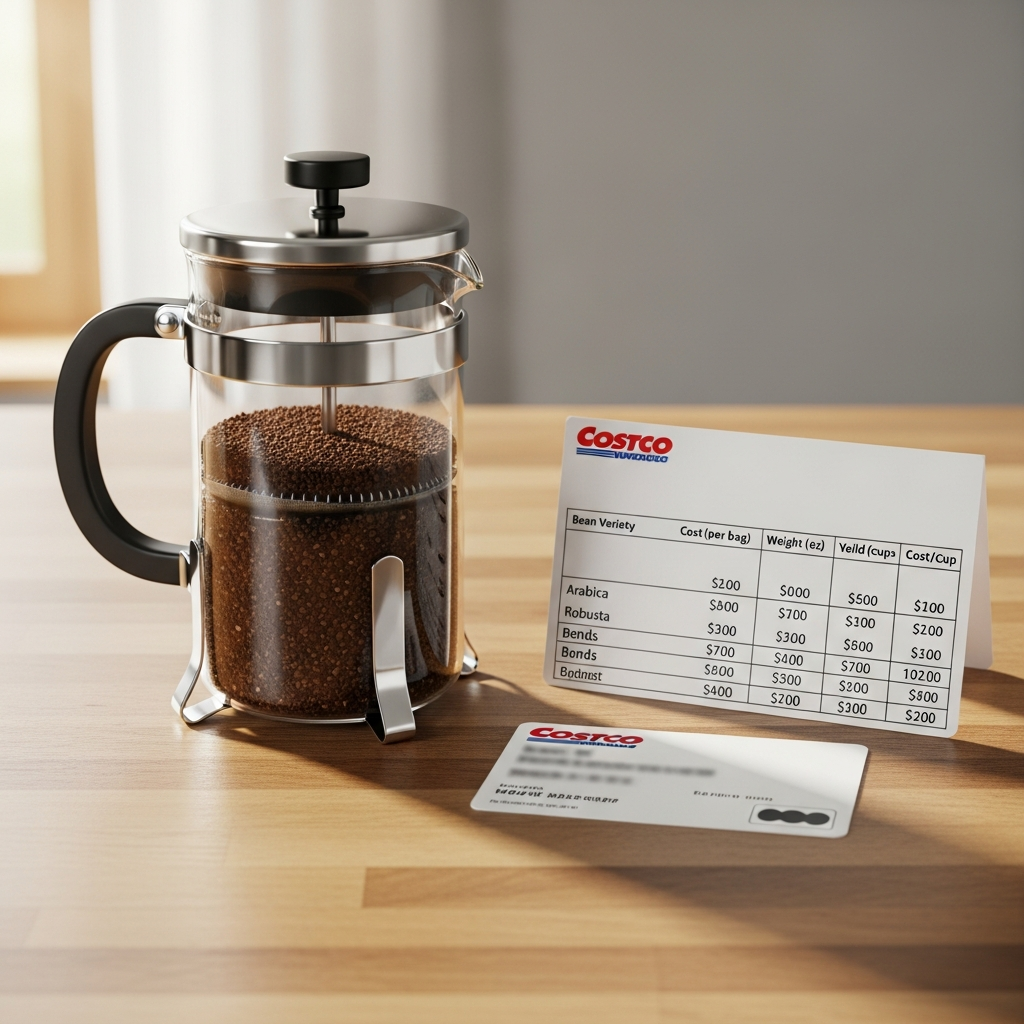
Kirkland House Blend: $8.99 ÷ 40 cups = 22.5 cents per cup. If you brew 5 cups per week, that’s $1.13 per week, or about $59 annually.
Kirkland Colombian Dark Roast: $9.49 ÷ 40 cups = 23.7 cents per cup. Same weekly math: $1.19 per week, $62 annually.
Starbucks whole bean at Costco: Usually $10.99 for a smaller bag (1.25-1.3 lbs). That’s roughly 30 cents per cup or more. $1.50 per week, $78 annually.
Local roaster: $14-18 per bag depending on the city. That’s 35-45 cents per cup. $1.75-2.25 per week, $91-117 annually.
The Costco advantage is real. Over a year, choosing Kirkland over a local roaster saves $32-57 if you’re a regular brewer. If you rotate between House Blend and Colombian Dark Roast, you’re still underneath 24 cents per cup average. That’s sustainable.
But here’s the qualifier I don’t see in most retail guides: you only get this savings if you’re using a grinder and buying whole bean. If you’re buying pre-ground or relying on the roastery to grind it, you lose the freshness advantage and you’re just buying commodity coffee at commodity prices. The Costco win is whole bean, coarse grind, and brewing within a week of opening the bag.
One final thought: Costco’s return policy is absurdly generous. If a bag tastes off, you can return it. That’s insurance against picking the wrong beans. Use that policy if the Colombian Dark Roast doesn’t work for your palate — swap it for House Blend or something else. I’ve never had a Costco cashier question a coffee return.
“`