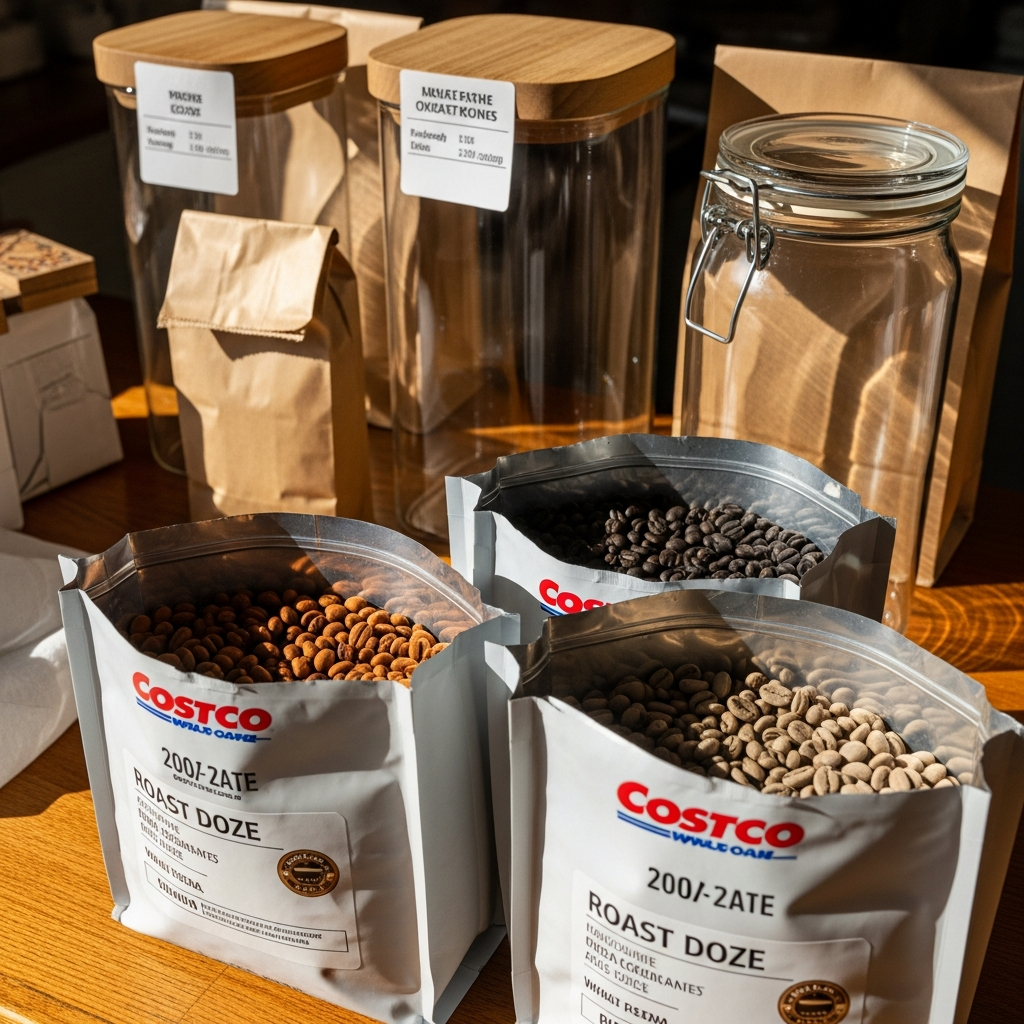
Why Bulk Coffee at Costco Gets Stale So Fast
I’ve been buying Costco coffee beans for six years now, and I used to assume that “fresh roasted” meant fresh. It doesn’t—not always. The first time I opened a two-pound bag of Kirkland Signature Medium Roast and it tasted like wet cardboard, I thought something was wrong with my palate. Turns out, something was wrong with the coffee.
Coffee beans have gotten complicated with all the marketing noise flying around. Here’s what I’ve learned: they have a genuinely narrow window where they taste like coffee and not like a stale basement. That window is typically two to four weeks after the roast date. After that? The oils oxidize, the aromatics fade, and you’re left with something that technically contains caffeine but tastes aggressively flat.
Costco’s supply chain, while efficient for getting bulk goods cheap, works against coffee freshness in three specific ways.
First, those massive bags sit in Costco warehouses that aren’t climate controlled the way specialty roasters control their storage. The average Costco is kept around 65 to 75 degrees Fahrenheit—which sounds reasonable until you factor in the fluorescent lighting overhead. Direct light exposure accelerates oxidation in whole beans. I didn’t know this until I started visiting my local roaster, who keeps inventory in opaque bins under cool, dim conditions.
Second, the supply chain is long. Frustrated by stale beans, I actually tracked the timeline using suppliers’ shipping records. Coffee roasted by the supplier, packed, shipped to regional distribution centers, then shipped again to your local warehouse. That’s easily adding ten to fourteen days before the bag hits the shelf. If that bag then sits in your Costco for another week or two before you buy it, you’re already three weeks out from the roast date when you get home.
Third—and this is the one I should have noticed sooner—Costco doesn’t rotate stock the way specialty shops do. The bags on the bottom shelf could have been there for a month. Nobody’s checking. The staff has literally no way of knowing which bags are oldest, and they’re not trained to prioritize coffee rotation like they might with milk or bread.
That’s what makes this problem endearing to Costco shoppers in a weird way—you have to become your own quality control. It’s not Costco’s fault exactly. It’s just how bulk retail works. But it means that buying coffee at Costco requires you to be an active participant in the freshness game, not a passive one.
Check the Roast Date Before You Leave the Store
Probably should have opened with this section, honestly. The roast date is literally the only piece of information that matters, and almost nobody checks it.
On Costco bags, the roast date is printed small—usually on the bottom or back side panel. I’ve had to use my phone’s flashlight to read it more than once. It’s formatted like “Roasted: 12/15/2024” or sometimes just a date stamp. Don’t confuse it with the “best by” date, which appears separately and is usually six months out. That best-by date is useless for your purposes.
What you’re looking for: a roast date within the last ten to fourteen days from when you’re shopping. If it says “Roasted 11/20” and today is 12/15, walk away. That bag has been sitting around for almost a month. If you’re shopping on 12/15 and you see a bag that says “Roasted 12/05,” grab it. That’s prime territory.
The red flag range is anything roasted more than twenty-one days ago. I’ve found bags at Costco dated six weeks back. They’re still sitting on shelves because they didn’t sell, which tells you everything you need to know about quality.
Here’s a small detail that matters more than you’d think: some Costco locations rotate stock faster than others. The warehouse in my neighborhood moves coffee quickly—I usually find bags roasted within ten days. The one fifteen miles away? That location’s coffee often sits for three weeks. I started buying from the closer one just for this reason. Check your local Costco a few times to understand which location has better turnover.
Don’t expect staff to know about this. I asked a Costco employee once about the roast dates, and he looked at me like I’d asked about the molecular structure of tannins. They’re not trained for it. You have to be the expert here, which is annoying but also gives you an edge over other bulk buyers.
The Storage Mistake Everyone Makes
I used to store my Costco coffee in the original bag, sitting in a kitchen cabinet next to the microwave. Of course it got stale fast. The cabinet was warm—heat is the enemy. The bag wasn’t truly airtight—the fold-top closure isn’t reliable. And I was using the coffee over eight weeks instead of three.
The second I switched my approach, the coffee tasted noticeably better. Don’t make my mistake.
Here’s what actually works: transfer your beans to an airtight container immediately when you get home. I use a basic Oxo pop-top container from Target (they’re like $8 to $12). It’s not fancy, but it creates a real seal. Some people use glass mason jars with those rubber gasket lids—those work too. The point is killing oxygen exposure.
Store that container in a cool, dark spot. Not the kitchen cabinet above the oven. Not the fridge—I learned this the hard way when condensation ruined an entire bag. Cold plus humidity equals stale coffee because moisture seeps in through microscopic gaps in the seal. A pantry, a closet, the back of a counter away from direct sunlight. Boring locations are good for coffee.
Use the beans within three to four weeks of purchase. This isn’t a maximum lifespan where it suddenly tastes bad at day twenty-nine. It’s a sweet spot. Days one through fourteen? Perfect. Days fifteen through twenty-one? Still good. Days twenty-two through twenty-eight? Noticeably less vibrant. After that, you’re making coffee, not drinking coffee.
Temperature matters more than you’d expect. I started keeping my coffee in a cabinet in the hallway instead of near the kitchen, and the temperature difference (hallway stays cooler) made a real difference in the final cup.
Also, don’t store it near anything with a strong smell. Coffee is porous and will absorb odors. Keeping it next to spices, garlic, or cleaning supplies will influence the taste in ways you won’t consciously notice until you compare it to properly stored coffee.
Which Costco Coffee Brands to Buy for Longer Freshness
Not all Costco coffee moves at the same speed through the warehouse. Kirkland Signature Medium Roast is popular enough that it usually ships quickly, so the bags on the shelf tend to be fresher. I see younger roast dates on Kirkland Medium consistently—usually within two weeks.
Kirkland Dark Roast moves slower. I notice older roast dates on those bags. Dark roast also hides flavor degradation better (all that roasting masks staleness), which is maybe why people buy it without checking dates. But if you’re shopping for taste, Medium is your better bet at Costco.
Peet’s coffee, which Costco carries in some regions, has decent turnover too. The prices aren’t as low as Kirkland, but they’re competitive, and Peet’s bags often show fresher dates because Costco shoppers buying Peet’s are probably the same ones checking roast dates.
Here’s the honest part: availability varies by region and store. Some Costcos stock Lavazza, others stock Mountain Peak, others have brands I’ve never even seen. Don’t assume that because Kirkland works at your location, it works everywhere. Visit your store, check what’s available, then start tracking the roast dates you find. After three trips, you’ll know which brand and which time of week gets the freshest stock.
Don’t buy the expensive stuff at Costco assuming it’s fresher. Sometimes the $10 bag is fresher than the $14 bag, purely because the cheaper one sells faster. This is one scenario where high price doesn’t correlate with high quality.
When to Skip Costco Beans and Try Somewhere Else
If your local Costco has consistently old roast dates—like if you check three times and find bags roasted twenty-plus days ago—maybe it’s time to test a different supply.
Local roasters, even if they cost $2 to $4 more per pound, often guarantee fresher beans. Many roast to order or roast frequently throughout the week. If you find a local roaster within five miles of your home, spending an extra $24 for a two-pound bag that tastes dramatically better is worth the experiment.
Online roasters ship quickly and roast fresh. Yes, you pay shipping. But if you’re buying two pounds every three weeks, that’s a viable alternative to stale bulk coffee. Some even have subscriptions that reduce per-pound costs.
Your local coffee shop’s retail beans are another option. The same shop that’s making your espresso is probably selling bags they roasted days ago. Walk in and ask when the last roast was. Most specialty cafes roast in-house or get weekly shipments from local roasters.
This isn’t saying Costco coffee is bad. For the price—$7 to $9 per pound for whole beans—it’s genuinely competitive. But it only stays competitive if you’re buying it fresh and storing it right. If your local Costco doesn’t move coffee fast enough, the math changes.