What the Frappuccino Base Actually Is
I spent three years ordering Starbucks Frappuccinos multiple times a week — easily $200 a month — before I realized why every homemade version I attempted turned into a slushy mess halfway through drinking it. The coffee would separate. The ice would melt faster than it should. I’d taste mostly milk and vanilla, not that signature sweet-thick texture that makes the drink feel indulgent.
Here’s what I was missing: the base syrup. Starbucks doesn’t just throw coffee, milk, and ice into a machine. They use a proprietary Frappuccino base — a sweetened syrup thickened with xanthan gum that keeps the drink stable, prevents separation, and creates that glossy mouthfeel. When you skip this step and try to make a Frappuccino with just coffee and vanilla syrup, you’re missing the structural ingredient that holds everything together. Probably should have opened with this section, honestly, because once you understand the base, replicating the drink becomes straightforward.
The 4-Ingredient Base Syrup Recipe
This base takes 15 minutes active time, then a few hours to chill. Here’s what you’ll need:
- 1 cup white granulated sugar
- 1 cup water
- 1 teaspoon vanilla extract
- 1/2 teaspoon xanthan gum
Combine the sugar and water in a small saucepan over medium heat. Stir occasionally until the sugar dissolves completely — you’re making a basic simple syrup here. About 5 minutes is typical. You’ll watch the mixture shift from grainy to clear. Once it’s fully dissolved and barely steaming, remove it from heat and add the vanilla extract. Stir well.
Pour the warm syrup into a blender — this step matters more than you’d think. Let it cool for at least 15 minutes. Don’t add xanthan gum to the hot saucepan. If you do, it will clump into rubbery balls that won’t incorporate. I learned this the hard way on my second batch, wasting a full cup of syrup by not waiting.
Once the syrup hits room temperature, add the xanthan gum to the blender and blend on high speed for 30 seconds. You’ll hear it change sound — the xanthan gum hydrates and thickens the mixture visibly. What looked like thin syrup becomes slightly viscous. Pour it into a clean glass jar and refrigerate.
This base stores in the fridge for about a month. The texture stays consistent the entire time. I keep mine in a small squeeze bottle for easier measuring during assembly — saves a lot of time when you’re making multiple drinks.
How to Build a Coffee Frappuccino With the Base
For a 16-ounce copycat that tastes genuinely close to Starbucks, here are your proportions:
- 3/4 cup ice (about 6–8 regular cubes)
- 1/2 cup whole milk
- 1/2 cup strong cold brew coffee, or 2 teaspoons instant espresso powder dissolved in 2 tablespoons hot water (then cooled)
- 2–3 tablespoons of your homemade Frappuccino base
Blend order actually matters. Add the ice first, then milk, then coffee, then base. Blend on high for 45–60 seconds until completely smooth with no visible ice chunks. The base helps bind everything, so you’ll get that creamy consistency rather than a grainy slushy texture.
The vanilla version is your baseline — just follow the recipe above. But you can swap the base itself for flavor variations without needing separate recipes:
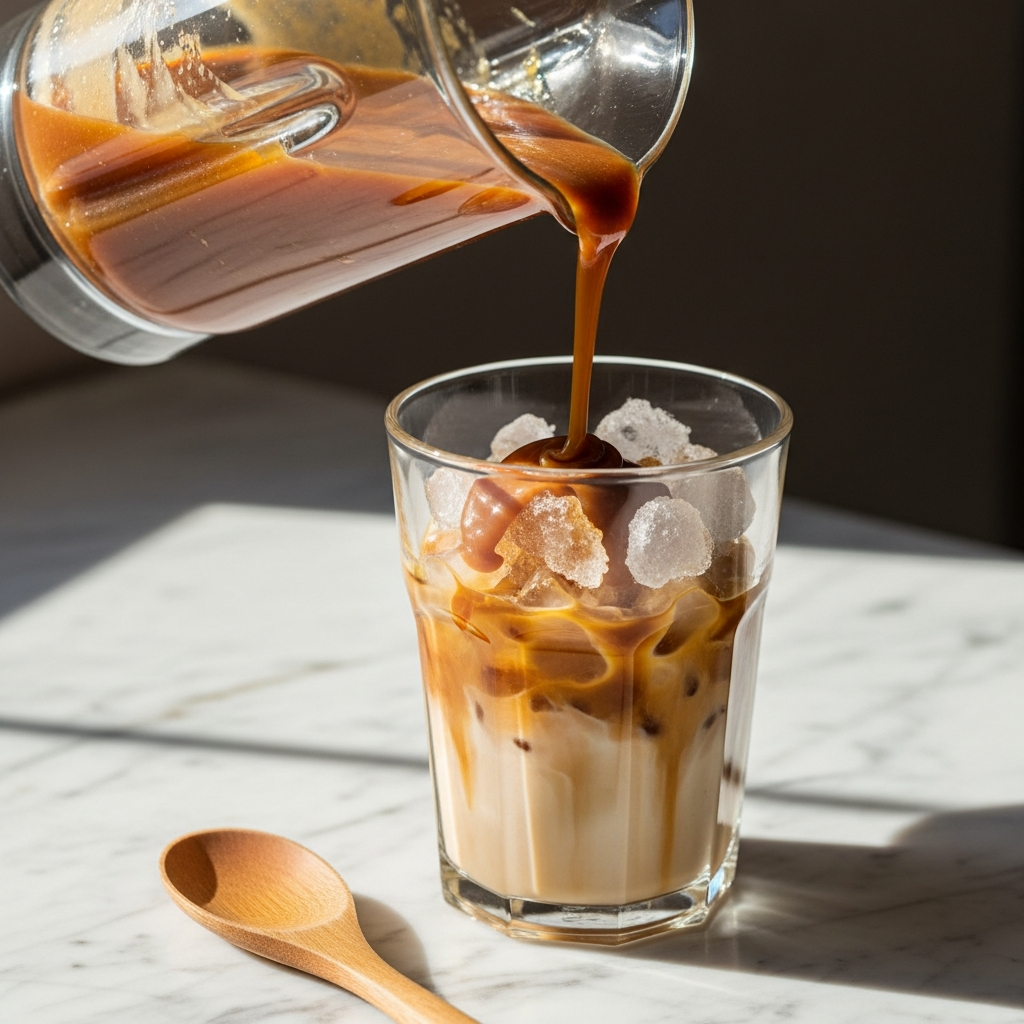
Caramel version: Replace 1/4 cup of the water with caramel sauce before simmering. Use the same sugar and vanilla proportions. You’ll get a deeper caramel note without the separation that usually comes from adding caramel syrup directly to a blended drink.
Mocha version: Add 2 tablespoons unsweetened cocoa powder to the finished warm syrup before cooling, then blend it in with the xanthan gum. This distributes the cocoa evenly rather than having it settle at the bottom.
Vanilla bean version: Scrape the seeds from half a vanilla bean into the syrup before cooling. You’ll see tiny black specks throughout the base — that visual detail actually sells the “homemade” angle in a way plain vanilla doesn’t.
Why Your Homemade Frappuccino Separates or Tastes Watery
The drink separates into layers: You’re not using the base. Without xanthan gum, there’s nothing holding the water in the coffee and the fat in the milk in suspension. They split apart. Make the base.
It tastes watery: You’re using too much ice relative to coffee. Use 1/2 cup strong coffee, not 1/3 cup. The base makes the drink thick, but weak coffee still tastes weak underneath it.
It’s grainy or icy: Your base wasn’t blended properly, or you added xanthan gum while the syrup was still hot. Reheat it gently in a microwave — 30 seconds, stir — then cool it fully before re-blending with another 1/2 teaspoon of xanthan gum. The texture will smooth out.
You blended for too long: Over-blending breaks down the ice into tiny pieces that melt faster and create a thinner drink. Stick to 45–60 seconds maximum. You want texture, not soup.
It doesn’t taste sweet enough: Your base may be old — the xanthan gum’s hydration weakens slightly over time. Make a fresh batch. Or use 3 tablespoons of base instead of 2 tablespoons per drink.
Cost per Drink vs the Drive-Through
A single 16-ounce Frappuccino at Starbucks costs $6.50–$7.50 depending on location and whether you add an extra shot. I spent roughly $360 a year on them before I started making my own.
One batch of base — using $0.50 of sugar, $0.15 of water, $0.10 of vanilla extract, and $1.20 of xanthan gum — makes about 8 Frappuccinos. That’s $0.24 per drink in base alone. Add $0.30 for coffee (or instant espresso), $0.40 for milk, and $0.06 for ice. Your total cost per 16-ounce copycat is roughly $1 before any specialty flavoring. Even if you buy premium instant espresso or cold brew concentrate, you’re hitting $1.50 maximum per drink. You’re saving $5–$6 per drink.
If you’re drinking two Frappuccinos a week — a pretty modest habit — you’re saving $500–$600 per year. That’s the math that finally made me stop ordering them.
The other win: you control sweetness and coffee strength. Starbucks pumps syrup into every drink automatically. You can dial yours down or up. Most people naturally use less syrup at home than Starbucks does, so you also end up with a less cloying drink.
If you’re already making other Starbucks copycat recipes at home, the base becomes even more valuable — check out our guides for homemade Starbucks whipped cream and flavored syrup recipes to round out your home café setup.