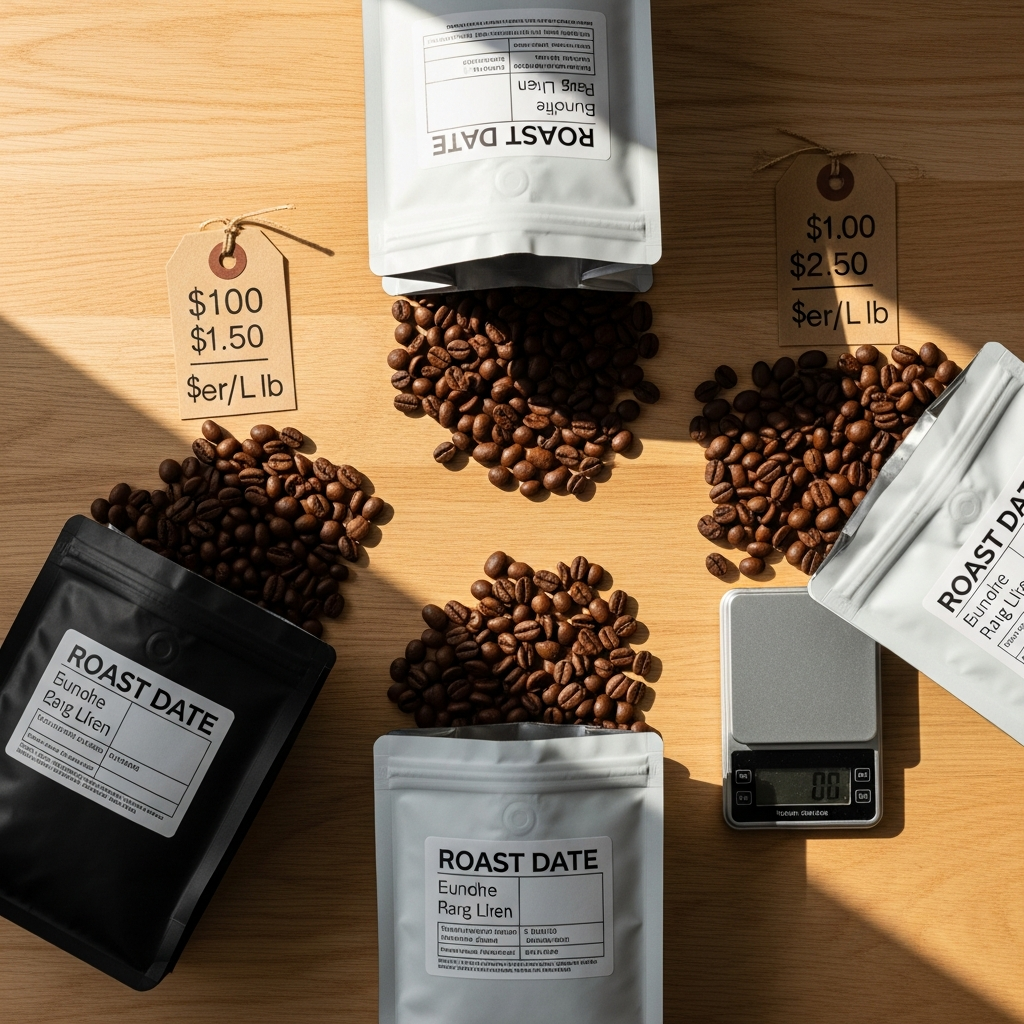
“`html
Best Costco Coffee Beans — Ranked
Coffee at Costco has gotten complicated with all the price noise flying around lately. I’ve been buying it there for five years — long enough to actually know what rotates through their shelves and watch prices climb while quality somehow stayed consistent, which is honestly rare. Right now, if you’re standing in that coffee aisle scrolling on your phone trying to decide between Kirkland or Peet’s, here’s what actually matters: shelf prices I’ve tracked myself, the real cost-per-ounce breakdown, and freshness signals you can spot before you even hit checkout.
Most “best coffee” roundups skip the retail details entirely. They don’t mention Costco’s inventory speed, roast dates on actual bags in front of you, or the fact that Kirkland Signature — their house brand — routinely outperforms expensive alternatives without charging you the premium markup. I’ve watched this play out across dozens of shopping trips.
Kirkland Signature Colombian — Best Overall Value
This is what I buy every time. Kirkland Signature Colombian medium roast, 2-pound bag, currently sitting at $10.49 at my warehouse. Do the math: roughly $0.33 per ounce. I haven’t seen that price point matched by equivalent single-origin bags from the Third Wave roaster crowd or from Peet’s.
The flavor lands exactly where it needs to — medium body, balanced acidity, subtle chocolate and nutty undertones creeping in. It’s not trying to be a light roast with bright florals or a dark roast with aggressive char. Straightforward, consistent, everyday bean that works without drama in French press, drip machines, espresso setups, and pour-overs without overpowering what the equipment itself brings to the cup.
Probably should’ve opened with this section, to be honest. Most people just want a bag they don’t have to think about. Kirkland Colombian delivers exactly that. The roast date printed on the back label — check the small type near nutrition facts — typically falls within 10–14 days of purchase. That matters more than people realize. I’ve compared bags side-by-side with Costco’s Peet’s option, and the Colombian maintains cleaner acidity because it’s fresher off the roaster by two to three weeks.
Year-over-year movement: $8.99 in early 2024 up to $10.49 now. That’s a $1.50 jump — roughly 16.7%. Still the best value on that entire aisle.
Kirkland Organic Arabica — Best if You Prioritize Certified Organic
The organic version sits directly next to the conventional Colombian, usually priced at $12.49 for the same 2-pound bag. That’s a buck more per bag, or roughly $0.39 per ounce against the Colombian’s $0.33.
Here’s what actually matters for the extra dollar: USDA organic certification means audited sourcing and processing without synthetic pesticides. I’m not going to claim organic coffee tastes objectively *better* — blind taste tests are messy and inconclusive — but if certification is your threshold, this runs 30% cheaper than what Peet’s charges for their organic offering, which hovers at $17–19 per 2-pound bag at Costco. That’s a real gap.
Flavor-wise, the profile skews slightly lighter than the conventional Colombian. Brighter acidity, more pronounced citrus notes, less chocolate depth. That’s typical for certified organic beans from this region because the processing method prioritizes clarity of origin characteristics over roasted body.
The trade-off is simple: you pay $1–2 more per bag for the certification badge. Still radically cheaper than specialty organic brands cluttering the natural foods aisle. Roast date freshness works the same as the Colombian — expect that same 10–14 day window from roast to your cart.
Peet’s Major Dickason’s Blend — Best if You Want a Familiar Premium Option
Peet’s Major Dickason’s Blend, 2-pound bag, runs $12.99 to $13.49 depending on what your local inventory looks like. That’s roughly $0.41 to $0.42 per ounce — a 24% premium over Kirkland Colombian.
Why include it? Because it’s reliably there. Kirkland variants rotate. I’ve walked in on a Wednesday and found the organic completely sold out, forcing me to grab something different. Peet’s Major Dickason’s shows up almost every time. If you already know this blend works with your setup and you want consistency over squeezing out every penny, that per-ounce premium is small enough to justify the convenience factor.
The flavor profile — darker roast, bolder body, heavier chocolate and woodsy notes. Not better or worse than Kirkland, just different. Some espresso machines pull cleaner shots with it. Some drip coffee makers tend toward over-extraction. The roast date on Peet’s bags typically runs 3–4 weeks old by the time it hits Costco shelves, which is still acceptable but noticeably older than Kirkland’s rotation speed.
This is the fallback. Kirkland’s sold out and you need something today? Peet’s fills the gap without forcing you into a questionable compromise.
How to Compare Coffee Freshness at Costco’s Shelf
The roast date. That single signal separates tolerable coffee from stale inventory.
Go to the coffee section. Grab a bag and flip it over. Look for “Roasted on” followed by a date — back label, small type, usually near the nutrition facts. Two to three weeks old? Excellent. Five to six weeks? The flavor’s already degraded noticeably — oils oxidize, brightness fades, you’re left with flat coffee that tastes like it’s been sitting.
Costco moves inventory fast. That’s a genuine advantage over grocery stores where coffee can languish for months. But shipments don’t all arrive at once, and bags near the bottom of the stack are older.
Here’s the actionable step: pick the bag with the most recent roast date. If every visible bag says roasted 3+ weeks ago, ask a staff member when the next shipment hits. They’ll usually know — Costco restocks these fast-moving items on a predictable schedule, typically Tuesday or Wednesday mornings at most locations.
I’ve done blind comparisons. Kirkland Colombian roasted 10 days ago beats Kirkland Colombian roasted 35 days ago. Every time. No contest. The acidity is brighter, the finish is cleaner, the aroma is sharper. This matters more than most coffee buying advice ever admits.
Year-Over-Year Costco Coffee Price Changes (2024 vs 2025)
Kirkland Signature Colombian 2-pound bag: $8.99 (early 2024) → $10.49 (current). That’s $1.50 per bag, or 16.7% year-over-year. Cost-per-ounce shift: $0.28 to $0.33.
Kirkland Signature Organic Arabica 2-pound bag: $10.99 (early 2024) → $12.49 (current). Same $1.50 increase, or 13.6% year-over-year. Cost-per-ounce shift: $0.34 to $0.39.
Peet’s Major Dickason’s Blend 2-pound bag: $11.99 (early 2024) → $13.49 (current). Also $1.50 increase, or 12.5% year-over-year. Cost-per-ounce shift: $0.37 to $0.42.
All three absorbed roughly the same absolute price jump — about a buck-fifty per bag. Percentage-wise, the house brand Colombian took a bigger hit, but it started lower, so it’s still cheapest in absolute terms.
Why the rise? Drought in Brazil tanked arabica yields. Shipping costs stayed elevated. Packaging materials went up. These are real supply-chain factors, not artificial markup games. Costco’s margins on coffee are actually tight compared to grocery chains — they use coffee as a traffic driver, not a profit center.
Is now a good time to buy? Yes. Prices stabilized since March 2024. They’re not coming down. If you’re a regular buyer, locking in consumption at current prices rather than waiting is defensible. Coffee prices don’t crash — they plateau and rise slowly.
I stock up when fresh roasted inventory appears — usually Tuesday mornings. A case of six 2-pound bags of Kirkland Colombian runs about $63 now versus $53.94 in early 2024. For someone burning through a bag every five days, that’s a real annual increase around $120. Worth acknowledging, but not worth switching to cheaper brands that taste noticeably worse.
The Kirkland Colombian stays at $0.33 per ounce, freshness is consistent, quality didn’t decline despite the price hike. That’s why it stays in my cart every single trip.
“`