The Barraquito Recipe — Exact Ratios
Barraquito coffee has gotten complicated with all the vague tutorials and Tenerife travel fluff flying around. As someone who spent three years chasing a genuinely perfect version of this drink, I learned everything there is to know about the layering, the ratios, and the dozen small ways it falls apart. Today, I will share it all with you.
Start with the right glass. A small clear one — roughly 150ml capacity, something like a tall espresso cup. This isn’t about aesthetics. The visual layers are the entire point. Frosted glass defeats the purpose entirely. You need to see what you’re building.
Your ingredient list:
- 15–20ml sweetened condensed milk (I use 18ml as my baseline)
- 30ml espresso (single shot, standard pull)
- 20ml whole milk, lightly frothed — not steamed into stiff foam, and that distinction is critical
- One cinnamon stick
- One strip of lemon zest
- 15ml Licor 43 (optional, explained below)
The layering sequence, in exact order:
- Pour the sweetened condensed milk into the bottom of the glass. Don’t stir it. It stays put on its own.
- If you’re using Licor 43, add it now. It floats between the condensed milk and the espresso — its density falls right between the two, which is what makes the middle layer work.
- Pull your espresso shot. Then wait. Sixty to ninety seconds, minimum. I’ll explain why in the troubleshooting section, but don’t skip this.
- Pour the espresso slowly over the back of a bar spoon held just above the condensed milk. The spoon slows everything down. Take 8–10 seconds on this pour — not a quick glug.
- Top with lightly frothed whole milk. It should be velvety and pourable, almost like wet velvet. Not stiff. Definitely not canned whipped cream.
- Slide the cinnamon stick down into the glass. Place the lemon zest peel on top or tuck it into the foam.
The drinker stirs the cinnamon and lemon in themselves, at the table. Those aren’t garnish. They’re flavor components — and they don’t get pre-mixed.
Why the Layering Order Actually Matters
Probably should have opened with this section, honestly. The whole thing works because of density differences between the liquids, and without understanding that, you’ll get frustrated and quit after two attempts.
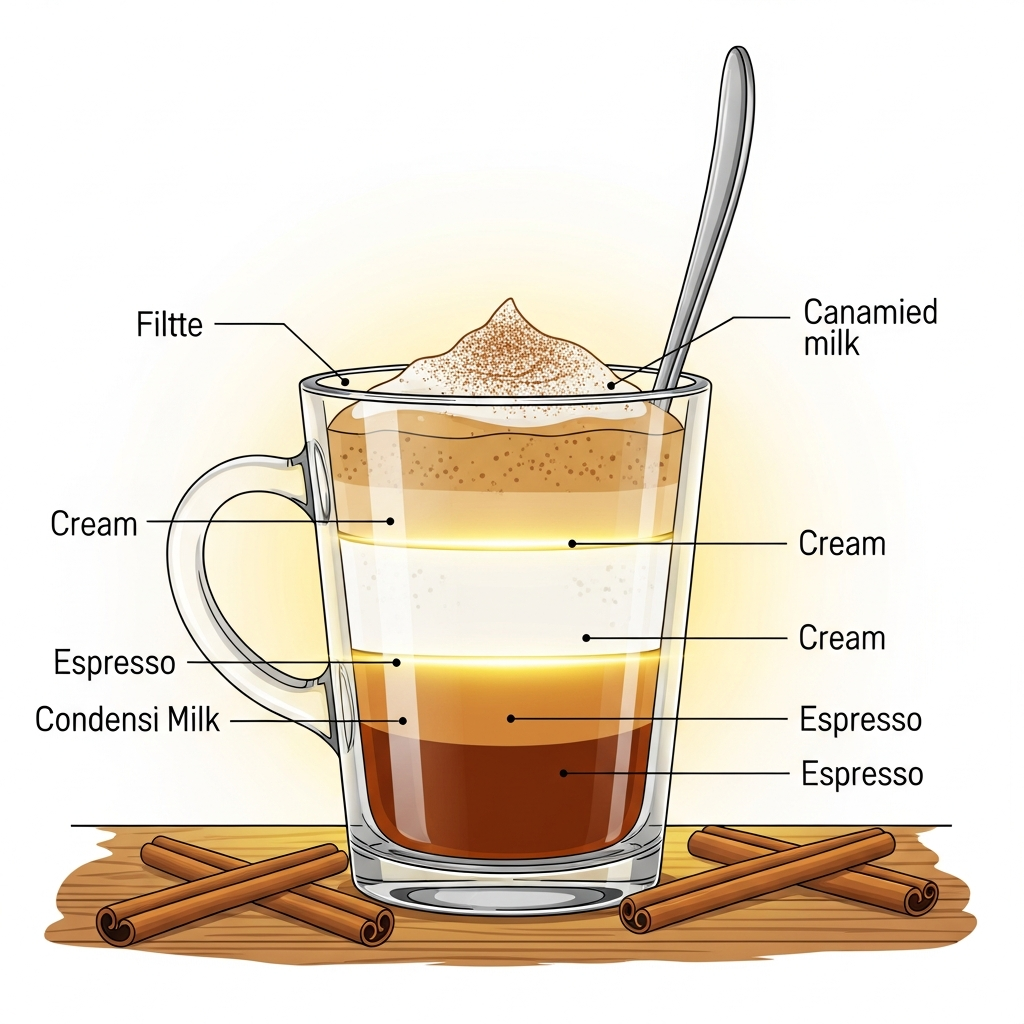
Sweetened condensed milk sits at roughly 1.3 grams per milliliter. Espresso runs close to water — about 1.0 g/ml. Milk foam comes in under 1.0 g/ml because it’s mostly air. That’s why they stack. Denser liquids sink. Lighter ones float. Simple physics, genuinely useful.
Flip the order and everything collapses. Pour espresso first and the condensed milk sinks straight through it — like dropping a stone into a puddle. You lose the visual separation that defines the drink. What you’re left with is murky brown liquid with no layers. Just sad espresso with condensed milk stirred in. Not the same drink at all.
Licor 43 wedges into the middle layer because its density falls between the other two. That matters more for structure than for flavor — though it does add a pleasant vanilla-citrus note. A properly layered barraquito shows four distinct strata when the light catches it right. That’s the target.
Here’s the practical fix when things go wrong: mixing layers in real time means your espresso is too hot or you’re pouring too fast. Even slowing down by a couple of millimeters per second makes a visible difference. Use the spoon. Let the shot cool to around 75–80°C before it hits the condensed milk. Sounds fussy. Isn’t, after you’ve done it twice.
Barraquito vs Leche y Leche — What’s the Difference
These two drinks get confused constantly. I spent an embarrassing stretch of time in a café in Las Palmas being served the wrong one before I figured out how to order correctly. Don’t make my mistake.
But what is leche y leche? In essence, it’s condensed milk and evaporated milk — no whole milk, no frothing. But it’s much more than that difference in ingredients. It’s heavier, richer, more homogeneous. You stir it together. A barraquito, by contrast, keeps its components visually distinct and always — always — includes lemon zest and a cinnamon stick. Those aren’t optional. If a café hands you something without the lemon peel and cinnamon stick for the drinker to work in themselves, it’s not a barraquito. Take a clear position on this.
The leche y leche is thicker. More dessert-like. The barraquito is brighter, lifted by the citrus and spice. One is an afternoon drink. One is breakfast, or sometimes evening. That’s what makes the barraquito endearing to us obsessives who keep making it at home — it’s specific. Particular. A barraquito without lemon and cinnamon is just a leche y leche with an identity crisis.
Making It Without Licor 43
Licor 43 is a Spanish vanilla-citrus liqueur. It’s genuinely hard to find outside specialty shops — I spent three weeks calling liquor stores across Portland before I gave up and figured out a simpler path. The bottle I eventually ordered online ran about $28 with shipping. That was frustrating.
So, without further ado, let’s dive in to the easier solution. Add a few drops of vanilla extract directly into the condensed milk layer before you build the rest of the drink. Stir it in while the condensed milk is still sitting alone in the glass. Same flavor profile, no specialty sourcing required.
Here’s the thing nobody mentions: the Licor 43 version is actually more of an evening or tourist-menu variation. Locals in the Canary Islands often drink it with no alcohol at all. Some cafés skip the liqueur entirely and only add it when a customer specifically asks. Making it without Licor 43 isn’t a compromise — it’s the breakfast version. Permission granted.
The One Thing Most Home Versions Get Wrong
I’m apparently someone who has made this drink around 200 times now, and watching it fail taught me more than watching it succeed. The single most common failure point is espresso temperature — and it’s almost always the culprit.
A standard shot pulls at 90–93°C. Pour it directly over the condensed milk at that temperature and the heat thins the condensed milk instantly — like watching ice cream melt in fast-motion — and the layers collapse into brown sludge. That happened to me four times before someone finally told me to wait. Sixty to ninety seconds. Just sit there. The espresso won’t go cold. The flavor stays intact. The layers hold.
The second failure I see constantly: people use canned whipped cream. Aerosol whipped cream kills the texture entirely. I’m apparently someone who tried this once thinking it would be fine, and it was not fine. A small handheld frother — a basic Zulay or similar, around $10 — works well. A steam wand works better. An aerosol can works not at all.
Those two fixes will save you. Temperature first. Real frothed milk second. Everything else is just measuring carefully and pouring slowly.