The Three Culprits Behind Bitter French Press
French press coffee has gotten complicated with all the advice flying around, but the bitterness issue? That’s actually simple. Your grind size is too fine. Your water temperature is too hot. You’re steeping the coffee for too long. That’s it. No mystical coffee bean quality excuses, no “this roaster is just bitter.” It’s mechanics. Fix one of these variables and your next cup will be noticeably better.
Your Grind Size Is Too Fine
I learned this the hard way about three years ago when I bought my first French press — frustrated by cup after cup of aggressive bitterness, I finally realized what was happening. I was grinding coffee the same way I did for my drip machine: medium-fine, almost powdery. Every single cup came out tasting like I was chewing on burnt wood.
Here’s why it happens. Fine grounds have more surface area. Water contacts them more completely. Extraction happens faster and more intensely. In a French press, that extraction keeps happening for the entire 4-minute brew time. Fine grounds plus time equals over-extraction, and over-extraction tastes bitter.
Your French press grind should be noticeably coarser than drip coffee — comparable to sea salt or coarse sand. Not quite as chunky as peppercorns, but close. If you look at it and think “that seems too big,” it’s probably right-sized. When I switched to a medium-coarse grind on my Baratza Encore (setting 25–28, if you have that model), the bitterness vanished immediately.
Don’t have a grinder with numbered settings? Do this: grind a small batch and feel it between your fingers. It should feel gritty and loose, not paste-like. You should be able to distinguish individual particles. If you can’t see space between the grounds when they’re wet, they’re too fine.
Probably should have opened with this section, honestly. Grind size accounts for most bitter French press problems I’ve encountered, and it’s the easiest variable to control.
You’re Using Water That’s Too Hot
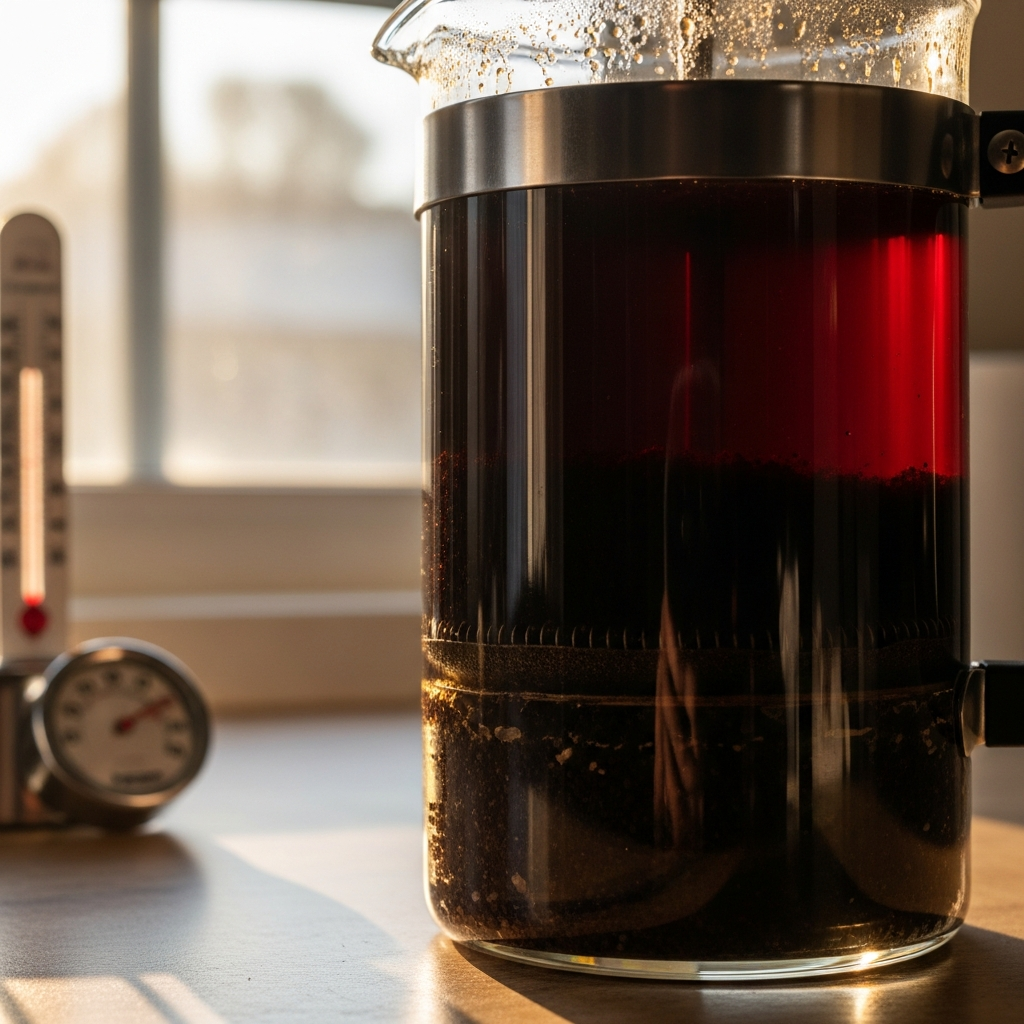
The ideal water temperature for French press is 195–205°F. Most people pour straight from a boiling kettle at 212°F. That 7–10 degree difference creates noticeably more bitterness.
Why? Hotter water extracts faster. It pulls more soluble compounds from the grounds more aggressively. Some of those compounds taste pleasant and flavorful. Some taste harsh and bitter. The hotter the water, the more of the harsh ones you get.
You don’t need a thermometer for this — boil your water, wait 30 seconds, pour. That cooling window is usually enough to drop you into the safe zone. If you have a kettle with a temperature dial (I use a Fellow EKG, which runs about $195), set it to 200°F and forget the guessing game.
The common mistake: pouring straight from a rolling boil while the kettle is still steaming. I did this for months. The water is legitimately too hot at that moment. Wait. Let it sit. The 30-second wait isn’t fancy or pretentious — it’s just smart extraction chemistry.
You’re Steeping Too Long
Standard French press brew time is 4 minutes. Some people go longer because they think it makes stronger coffee. It doesn’t. It makes more extracted coffee, and there’s a real difference.
At 4 minutes with proper grind size and water temperature, you’re extracting the good stuff. At 5 or 6 minutes, you’re pulling out the compounds that make coffee taste sharp and acrid. The coffee isn’t stronger — it’s over-extracted and bitter.
I watch people use a French press and they often forget to start timing. They pour water, chat for a minute, maybe walk away. Then they come back and think “I’ve been waiting, so it must be done” and press it at 6 or 7 minutes. Don’t make my mistake.
Use a timer. Phone timer, kitchen timer, whatever. Start it the moment you pour the water. At 3 minutes and 50 seconds, give the grounds a gentle stir. At 4 minutes exactly, press slowly — the whole press-down should take 20–30 seconds. Faster pressing doesn’t help.
Try This Fix First
Here’s the exact sequence I’d run if my French press tasted bitter right now:
- Use a medium-coarse grind. If you’re buying pre-ground, find a bag labeled “French press” specifically. Peet’s and Lavazza both make solid options in the $8–12 range. If you’re grinding at home, use setting 6–8 on a burr grinder if you have that info available.
- Heat water to 200°F. Boil it, wait 30 seconds, pour.
- Brew for exactly 4 minutes using a timer.
- Warm your French press first by rinsing it with hot water before you add grounds — a cold vessel absorbs heat and cools your water faster.
- Pour a cup and taste it.
I did this exact sequence last week when I switched to a new bean from a local roaster and got that bitter twang again. It was the grind — they must have ground it at a café setting before bagging it. Adjusting to coarser fixed it completely.
If it’s still bitter after trying all three variables, move to the next one. Change one thing at a time so you know what actually made the difference. Some coffees are just more bitter by nature — darker roasts, Brazilian beans — but that’s different from extraction bitterness. Extraction bitterness tastes harsh and sharp. Darker roast bitterness tastes like chocolate or cocoa.
The troubleshooting order matters. Grind size first because most people get this wrong and it’s the easiest fix. Temperature second. Brew time last. Start there and you’ll hit the problem within a cup or two.