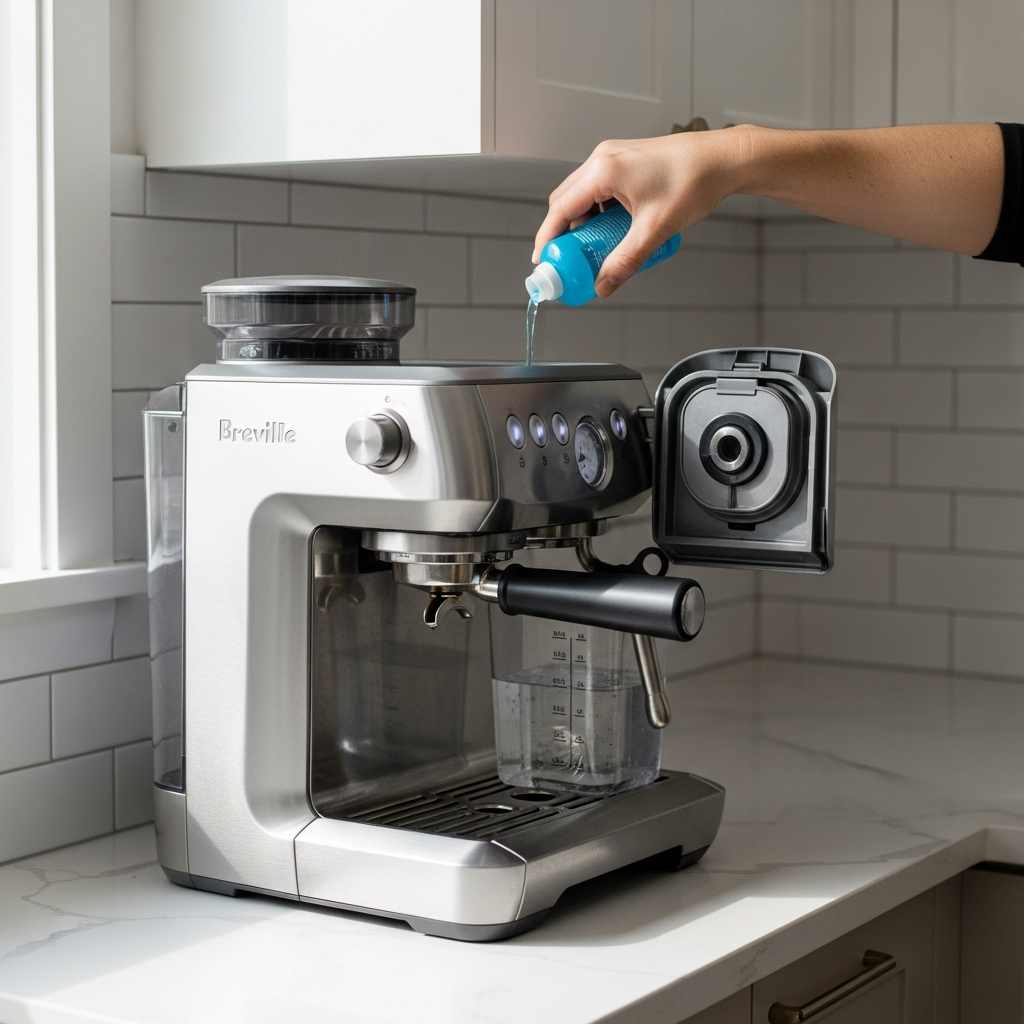
Descaling a Breville espresso machine has gotten complicated with all the model-specific procedures and descaler debates flying around. As someone who’s descaled six different Breville models over the years — Bambino Plus, Barista Express, Infuser, and a friend’s Oracle Touch — I learned everything there is to know about keeping these machines free of scale. Today, I’ll share it all with you.
Here’s the bottom line: scale is the #1 killer of home espresso machines. That white, chalky mineral buildup from calcium and magnesium in your water coats the inside of your boiler, thermocoil, and water lines. Left alone, it chokes water flow, drops brew temperature, and will eventually brick a $700 machine. I’ve seen it happen. Fifteen minutes of descaling every few months prevents all of it.
How Often Should You Descale?
Breville says every 2-3 months. The real answer depends almost entirely on your water.
Soft Water (0-60 ppm / 0-3.5 gpg): Every 4-6 months. If you run a Brita or similar filter, you’re probably here.
Moderate Water (61-120 ppm / 3.5-7 gpg): Every 2-3 months. Most US municipal water falls in this range.
Hard Water (121-180 ppm / 7-10.5 gpg): Every 6-8 weeks. White deposits on your faucets? That’s hard water.
Very Hard Water (180+ ppm / 10.5+ gpg): Monthly. Honestly, consider bottled water or a treatment system like Third Wave Water or BWT filters at this point. Your machine will thank you.
Cheap test strips from Amazon or any hardware store will tell you your number. Worth knowing — water hardness affects espresso taste just as much as it affects machine longevity.
Breville Descaling Solution vs. Citric Acid vs. Vinegar
Everyone asks this. And the answer actually matters.
Breville’s Official Descaling Powder (BES007)
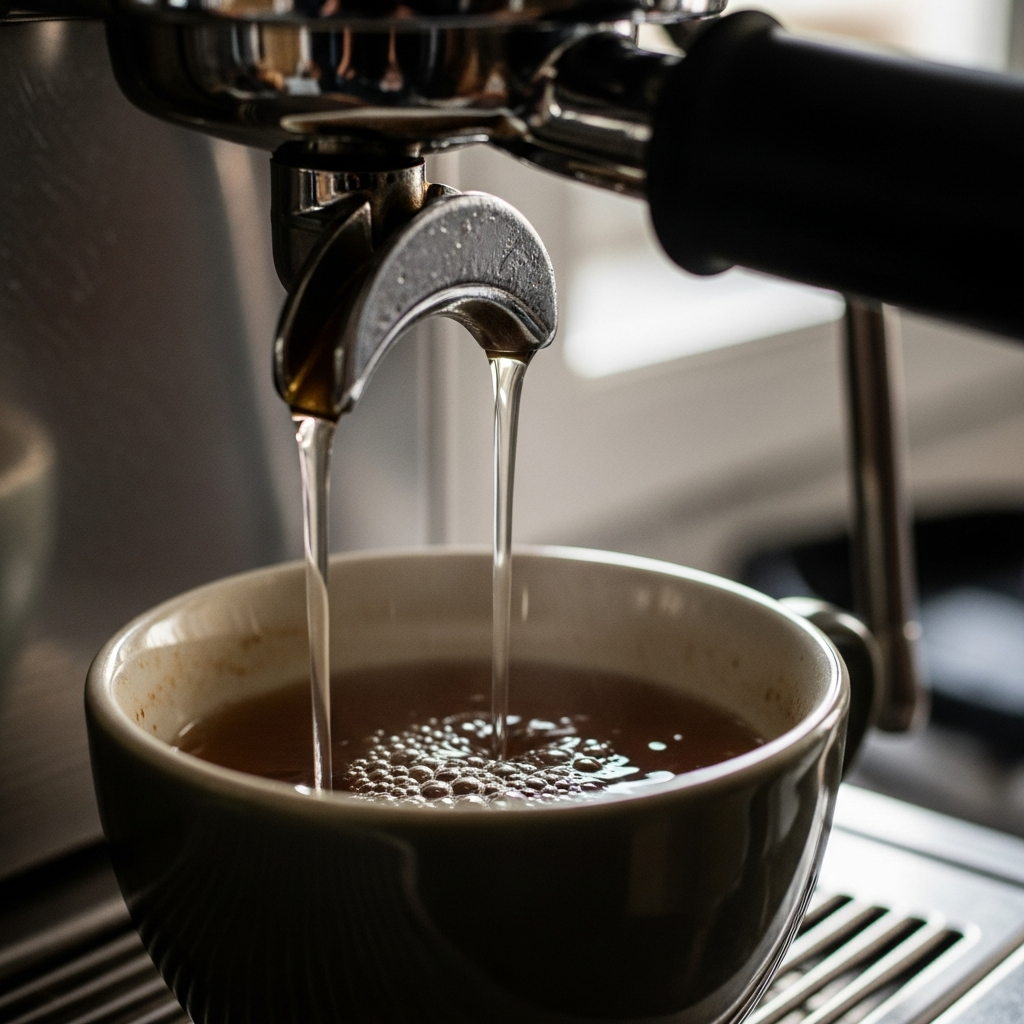
Powder packets you dissolve in water. Active ingredient is mostly citric acid with some surfactants. Works well, rinses clean, keeps your warranty intact. Downside is cost — about $3-4 per cycle. For what amounts to fancy citric acid, that’s a hefty markup.
Citric Acid Powder
This is what I use and what I recommend to everyone. Food-grade citric acid powder is literally the active ingredient in almost every commercial espresso machine descaler. Mix 2 tablespoons (about 30g) per liter of water. Odorless, rinses clean in 2-3 cycles, costs roughly $0.25 per descale when you buy a bag. Chemically identical to the branded stuff — minus the branding tax.
White Vinegar
I’m going to be blunt: do not use vinegar in your Breville. Breville explicitly warns against it in their manuals. Using it can void your warranty. Beyond warranty concerns, acetic acid (the active compound) takes 3.5 times longer to dissolve the same amount of scale compared to citric acid. It leaves a lingering taste and smell that needs 5+ rinse cycles to clear. And with repeated use, it degrades rubber gaskets and O-rings inside the machine.
My recommendation: Food-grade citric acid. Same effectiveness as Breville’s branded powder at a fraction of the price. Won’t void your warranty or eat your seals.
How to Descale the Breville Barista Express (BES870)
Most popular Breville on the planet, so let’s start here. This works for the BES870XL and BES870BSS too.
What you need: Descaling solution (citric acid or Breville BES007), a 2-liter container, about 20 minutes.
Step 1: Empty the water tank. Remove any water filter if you have one installed.
Step 2: Mix your solution and fill the tank to the 2-cup mark inside the reservoir. Using citric acid? Dissolve it in warm water first, then fill.
Step 3: Place a big container (2 liters minimum) under the group head and steam wand. Empty the drip tray.
Step 4: Enter descale mode. Machine powered off — press and hold the 2 CUP button while pressing POWER. Hold both until the POWER button starts flashing. You’re in descale mode.
Step 5: Press 2 CUP to start. Machine pumps solution through the group head. Takes several minutes. It’ll pause and restart multiple times — that’s normal, don’t touch anything.
Step 6: When the group head cycle finishes, turn the steam dial to steam position. Machine now pumps solution through the steam wand and hot water spout. Let it run until the tank empties.
Step 7: Rinse. Fill tank with fresh water (no solution), run the entire cycle again. Do the rinse twice to be safe.
Step 8: Exit descale mode — press POWER to turn off, then turn back on normally.
If your Barista Express has issues beyond scale, our Breville Barista Express troubleshooting guide covers the 10 most common problems.
How to Descale the Breville Barista Pro (BES878)
The Barista Pro has an LCD screen that walks you through most of it. Much nicer experience.
Step 1: Empty tank, remove water filter.
Step 2: Fill tank with solution to the DESCALE line (marked inside).
Step 3: 2-liter container under portafilter and steam wand.
Step 4: On the LCD: Menu > Maintenance > Descale. Machine guides you from here.
Step 5: Follow prompts to run solution through group head and steam wand. About 15 minutes total.
Step 6: When prompted, empty tank, refill with fresh water for the auto-rinse.
Heads up: Don’t let more than 5 minutes pass between steps. Machine times out and exits descale mode, forcing you to start over. Learned that one the annoying way.
How to Descale the Breville Barista Touch (BES880)
Full-color touchscreen makes this the easiest Breville to descale.
Step 1: Tap the Settings gear icon (upper right of the touchscreen).
Step 2: Select “Descale Cycle” and tap Start.
Step 3: Follow on-screen instructions — empty drip tray, place container under portafilter and steam wand, fill tank with solution to the marked line.
Step 4: Machine runs it automatically, cycling solution through all internal pathways. About 20 minutes total.
Step 5: When prompted, refill with fresh water. Machine runs 2-3 rinse cycles automatically.
How to Descale the Breville Bambino and Bambino Plus (BES450, BES500)
No screen on these, so you need a button combo to get in.
Step 1: Power off by pressing 1 CUP and STEAM simultaneously.
Step 2: Wait 2-3 minutes for full cooldown.
Step 3: Press and hold 1 CUP and STEAM together for 5 seconds. Both buttons light up — you’re in descale mode.
Step 4: Fill tank with solution to MAX line. Container under portafilter (locked in without coffee) and steam wand.
Step 5: Press 1 CUP to start. Solution flows through the group head. Then turn steam dial to flush through the steam system.
Step 6: Refill with fresh water, repeat for rinse. Run at least 2 full rinses.
Step 7: Exit by pressing 1 CUP and STEAM simultaneously again.
How to Descale the Breville Infuser (BES840)
Same process as the Barista Express since they share most of the same internals.
Step 1: Empty tank, remove filter.
Step 2: Mix solution, fill tank.
Step 3: Container under group head and steam wand.
Step 4: Machine off. Press and hold 2 CUP while pressing POWER. Hold until POWER flashes.
Step 5: Press 2 CUP to run descale through group head. When done, turn steam dial to run through the steam circuit.
Step 6: Fresh water, two rinse cycles the same way.
How to Descale the Breville Oracle and Oracle Touch (BES980, BES990)
The Oracles are dual-boiler machines, which means descaling hits both the brew boiler and steam boiler independently. Takes longer but it’s more thorough.
Step 1: Oracle Touch: Settings > Maintenance > Descale. Oracle (non-touch): press and hold SELECT for 5 seconds to enter service menu, then select Descale.
Step 2: Follow on-screen prompts — empty drip tray and tank, add solution, containers under all outlets.
Step 3: Machine automatically cycles solution through both boilers, group head, steam wand, and hot water outlet. 25-35 minutes because of the dual boiler system.
Step 4: Rinse thoroughly when prompted. Don’t skip it — dual boiler needs more rinsing than single-boiler machines.
How to Descale the Breville Dual Boiler (BES920)
Same button-combo entry as the Barista Express, but longer runtime because of the dual boiler.
Step 1: Power off. Press and hold 2 CUP while pressing POWER.
Step 2: Fill tank with solution. Containers under all outlets.
Step 3: Press 2 CUP to run the cycle. Machine handles brew boiler and group head first, then automatically switches to steam boiler and wand.
Step 4: At least two full rinse cycles with fresh water. Residual descaler lingers longer in dual-boiler systems.
What the Descale Light Means (And How to Reset It)
Depending on your model, the alert shows as a flashing light, LCD message, or touchscreen notification.
Here’s what most people don’t realize: the alert is triggered by a brew cycle counter, not an actual scale sensor. After a set number of cycles, the machine assumes it’s time. This means the alert might come too early with soft water, or too late with very hard water. Use your actual water hardness to set the schedule; treat the machine’s alert as a general nudge.
Resetting the alert: Run the full descale cycle using the built-in descale mode. Counter resets automatically when the program finishes. If the light stays on, you probably exited early — re-enter descale mode and do the full cycle including all rinse steps.
On the Barista Express and Infuser, if “CLEAN/DESCALE” won’t go away, try the factory reset: power off, then power on while holding PROGRAM for 3 seconds. That clears internal counters.
Signs Your Breville Needs Descaling Now
Don’t wait for the light. Watch for these real-world symptoms that mean scale is already affecting performance:
Shots taking longer. If what used to be a 25-second extraction is now 35+ at the same grind setting, scale is restricting flow.
Weak steam. Scale in the steam boiler or circuit kills steam pressure. Milk taking noticeably longer to froth? Time to descale.
Lukewarm espresso. Scale insulates the thermocoil, blocking proper heat transfer. Cooler shots than usual = descale immediately.
Louder pump. Pump straining to push water through scaled passages makes it audibly louder.
Visible white buildup. If you can see deposits around the shower screen, steam wand tip, or tank valve — there’s definitely scale inside where you can’t see it.
If your machine is showing symptoms that descaling won’t fix, check our Breville Barista Express troubleshooting guide for deeper diagnosis, or our DeLonghi espresso machine troubleshooting guide if you own a DeLonghi. We’ve also got a dedicated guide to descaling DeLonghi machines.
When to Contact Support
If descaling doesn’t fix your flow or temperature issues, the buildup may be too severe for a standard cycle to handle. In extreme cases, scale can completely block internal passages. Call Breville at 1-866-273-8455 if the machine won’t enter descale mode at all, if flow doesn’t improve after two consecutive cycles, or if you hear grinding or scraping during descaling (pump struggling against heavy scale). They may recommend a professional deep clean or offer a warranty repair.
Final Thoughts
Descaling is the most overlooked maintenance step in espresso machine ownership, and it’s the one most responsible for premature machine death. I’ve said it before and I’ll keep saying it. A $15 bag of citric acid powder lasts years of descaling and can genuinely extend your Breville’s life by several years.
Set a recurring reminder based on your water hardness. Don’t skip it. Your espresso will taste better, your machine will last longer, and you won’t have the unpleasant surprise of a $700 machine dying two years in because you skipped a $0.25 maintenance step. Probably should have led with that, honestly.