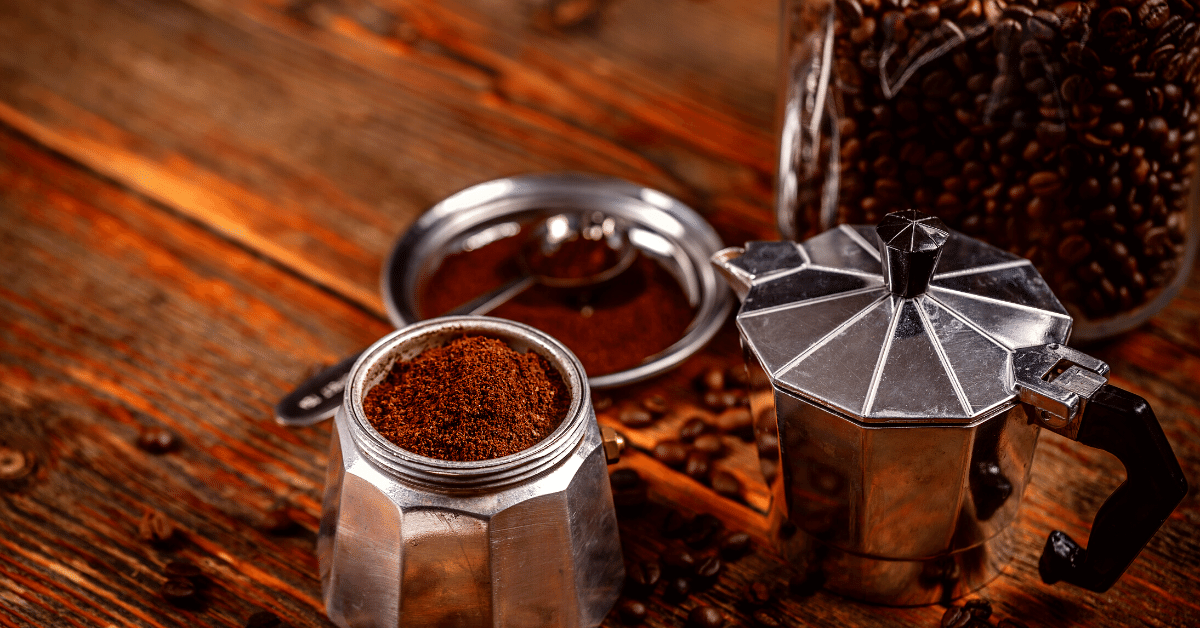
The best Moka-pot grind size is medium-fine: finer than standard drip coffee, but clearly coarser than espresso. It should feel slightly gritty rather than powdery. Fill the filter basket level without tamping or compressing the coffee. If the brew sputters, stalls or vents steam, stop and let the pot cool before checking for an overly fine grind or blockage.
Grinder numbers are not universal, so a setting copied from another grinder is only a starting point. Use the visual reference and taste adjustments below to dial in your own beans, grinder and Moka pot.
Moka Pot Grind Size at a Glance
| Question | Practical answer |
|---|---|
| Best starting texture | Medium-fine; finer than table salt, coarser and grittier than espresso powder |
| Can you use espresso grind? | Usually not; fine espresso grind may restrict flow or clog the filter |
| Can you use drip grind? | Yes as a test, but it may brew thin or sour; move slightly finer if flow is normal |
| Should you tamp? | No. Fill, level gently and leave the bed uncompressed |
| First adjustment for bitter coffee | Grind slightly coarser and use lower heat |
| First adjustment for weak or sour coffee | Grind slightly finer, provided flow is not restricted |
Bialetti’s own brewing guidance specifies a medium-fine grind—not a fine electric-espresso grind—and says to fill the funnel without pressing the grounds down. That distinction corrects a common mistake: a Moka pot makes concentrated coffee, but its grind should not automatically match a pump espresso machine.
What Does Medium-Fine Coffee Look Like?
A useful starting point sits between these familiar references:
- Coarser than espresso: individual particles should still be visible and feel faintly gritty between dry fingers.
- Finer than drip: the particles should be smaller than typical pre-ground filter coffee.
- Not powdery: a flour-like texture creates excessive resistance and more fines can migrate into the filter.
Descriptions such as “sand” are imperfect because sand varies widely. Compare the grounds with coffee from methods you already use: start a few steps coarser than your espresso setting, or several steps finer than your pour-over setting.
Moka Pot Grinder Settings
There is no accurate universal click number. Burr geometry, calibration, bean density and even zero-point alignment differ between grinders. Use manufacturer markings when the grinder has a Moka range; otherwise use these relative starting points:
| Grinder type | Starting approach | What to watch |
|---|---|---|
| Stepped burr grinder | Begin between the espresso and filter markings | Move only one or two steps per test |
| Stepless burr grinder | Start visibly coarser than your espresso setting | Make small collar adjustments |
| Hand grinder | Use its Moka recommendation if supplied | Clicks vary even between revisions of one model |
| Blade grinder | Pulse briefly and shake between pulses | Expect mixed particle sizes; avoid reducing everything to powder |
A burr grinder is easier to dial in because its particle distribution is more consistent. A blade grinder can work, but the combination of powdery fines and coarse fragments makes both bitterness and weak extraction more likely in the same brew.
How to Fill the Basket Safely
- Use the correct filter funnel for the pot.
- Add medium-fine coffee until the basket is full.
- Level the top gently with a finger or straight edge.
- Wipe loose grounds from the rim so the gasket can seal.
- Do not tamp, press or pack the bed.
Moka pots are designed around a full basket and the pot’s intended water level. Do not try to make half a batch by half-filling both chambers. Use a smaller pot when you want less coffee; our Moka-pot size chart shows the practical output of common sizes.
Grinding finer does not compensate safely for an underfilled basket. It increases resistance instead. If the safety valve releases steam or pressure repeatedly, remove the pot from heat, let it cool completely and inspect the funnel, filter plate, gasket and valve according to the manufacturer’s instructions.
Dial In by Flow and Taste
Change one variable at a time. Keep the same bean, dose, water level and heat while testing grind size.
If the coffee is bitter, harsh or burnt
- Move the grind slightly coarser.
- Reduce the burner to low or medium-low heat.
- Remove the pot when the stream turns pale and before prolonged violent sputtering.
- Try a lighter roast if dark-roast bitterness dominates.
Bitterness does not prove the grind is the only problem. Excessive heat and leaving the pot on the burner through the final sputter can produce harsh flavors even with an appropriate grind.
If the coffee is sour, thin or weak
- Move the grind slightly finer, as long as flow remains smooth.
- Confirm that the basket is filled level rather than partially filled.
- Use fresh coffee and check that the gasket seals correctly.
- Avoid a burner setting so high that water rushes through the bed.
If the brew stalls or only dribbles
- Remove the pot from heat and let it cool before opening it.
- Use a coarser grind next time.
- Do not tamp.
- Clean the filter plate and central column and check the funnel for damage.
- Make sure the gasket and rim are clean and the chambers are screwed together correctly.
Do not keep heating a stalled pot in an attempt to force coffee through. Persistent release from the safety valve requires cleaning, inspection or service—not more heat.
Can You Use Store-Bought Pre-Ground Coffee?
Yes, but choose coffee labeled for Moka or stovetop brewing. Standard filter grind may be too coarse, while coffee ground for an electric espresso machine may be too fine. If those are the only choices, filter grind is the safer initial test; it may taste weaker, but it is less likely to restrict flow than powdery espresso grind.
Pre-ground coffee loses aroma faster than whole beans, so buy a package size you can finish while fresh and close it tightly after use. See our coffee-for-Moka-pot guide for roast and blend considerations.
Does Pot Size Change the Grind?
Medium-fine remains the starting range for common Moka sizes, but larger pots can behave differently because the coffee bed, heat input and brew time change. Do not assume a setting perfected on a 3-cup pot will transfer exactly to a 9-cup model. Start close, observe the flow and adjust one small step at a time.
Moka Pot Grind Size FAQ
Is Moka-pot grind the same as espresso?
No. Moka grind is generally coarser than the fine grind used by pump espresso machines. Very fine espresso grind can clog or restrict a stovetop brewer.
Should Moka coffee be finer than pour-over?
Usually yes. A medium-fine Moka setting is normally several steps finer than a typical medium pour-over grind, but grinder scales differ.
Why are there grounds in my cup?
A small amount of sediment can occur, but excessive grounds suggest too many fines, an overly fine grind, a damaged or misplaced filter plate, or a worn gasket. Check the parts after the brewer has cooled.
Can I tamp Moka-pot coffee lightly?
No tamping is needed. Fill the funnel, level it and leave the bed loose. Pressing the coffee increases resistance and works against the brewer’s intended flow.
Bottom Line
Start medium-fine: finer than drip, coarser than espresso and gritty rather than powdery. Fill the basket completely, level it without tamping and brew on controlled heat. If flavor is harsh, move coarser; if it is weak and flow is healthy, move slightly finer. If flow stalls or the safety valve vents, stop heating and inspect the cooled brewer before trying again.