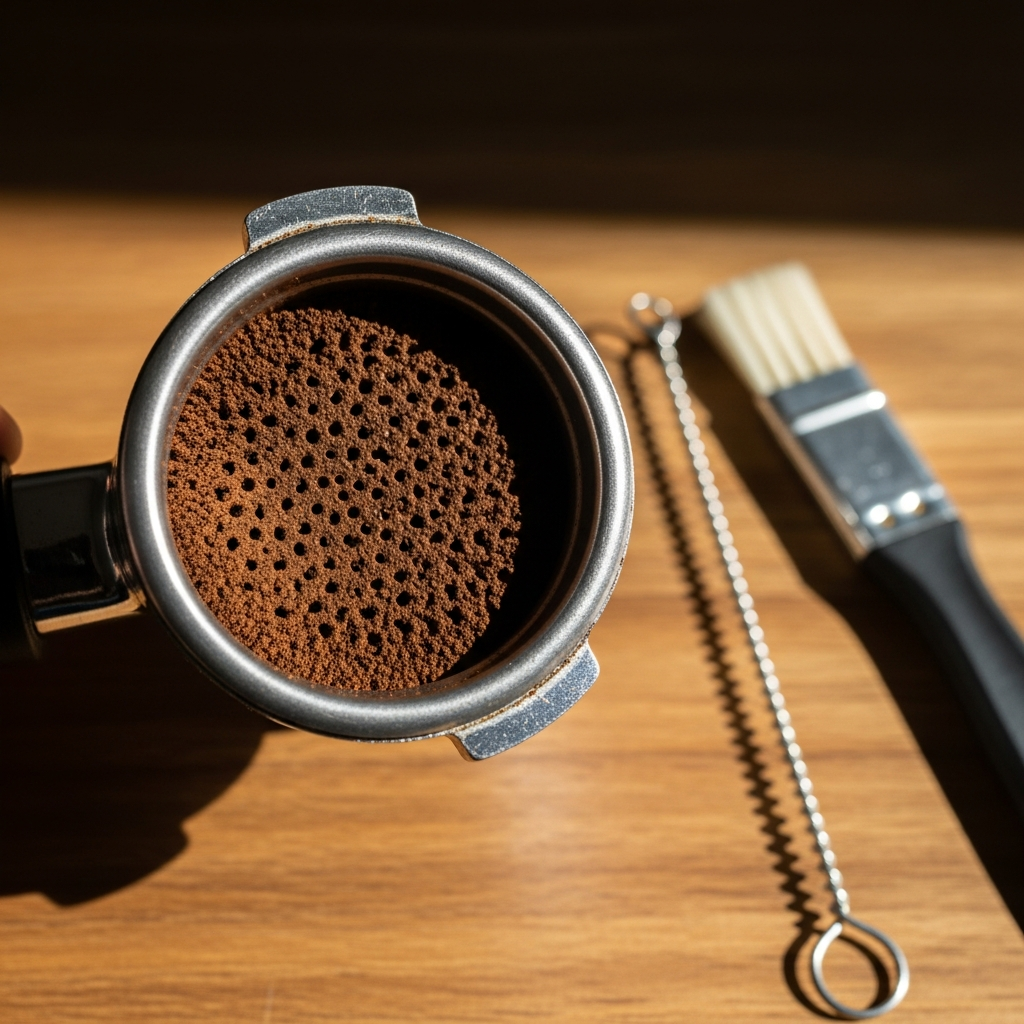
Why Your Basket Is Actually Clogging Right Now
I spent three weeks diagnosing my Gaggia Classic Pro’s portafilter basket clogging before I realized I was chasing the wrong problem. The basket would slow to a trickle mid-shot. Water would back up. I’d pull the handle and see grounds packed so tight they looked wet-concrete solid. My first instinct was descaling—I called the local espresso repair shop and they quoted me $80 just to clean the machine. Then I actually started testing things instead of assuming.
Basket clogging has gotten complicated with all the different advice flying around. But here’s what I discovered: it’s almost always one of three things. Understanding which one is happening in your specific machine changes everything about your fix.
The first culprit is grind size. Too fine, and grounds jam themselves into the basket holes like sediment in a river delta. The second is mineral deposits. Hard water minerals accumulate inside those tiny basket perforations until water literally can’t push through anymore — and running a descale cycle on your machine won’t necessarily clear the basket itself. The third is tamping pressure. Most people with a Gaggia Classic Pro don’t realize how much force they’re actually applying. They think they’re pulling with moderate pressure. They’re actually squashing espresso into a brick.
One of these is happening in your portafilter right now. The diagnostic part matters more than the fix because the fix depends entirely on which one.
The Grind Size Test That Takes 30 Seconds
Here’s what happened when I ground my beans too fine: water would sit on top of the puck for five seconds before trickling through. That’s your signal something’s wrong. A properly extracted shot should start flowing within two to three seconds of the pump engaging.
The tactile test works better than any description. Run your grinder at your current setting and collect some fresh grounds in your palm. Squeeze them gently. If they clump together like damp sand and hold their shape, you’re already too fine. The grounds should feel more like table salt — fine, sure, but granular enough to move independently when you shake your hand.
Now pull a basket from your portafilter without any puck. Run water through it at the sink. Does it spray through immediately in a diffuse pattern? That’s what unobstructed flow looks like. Now tamp some of your current grounds into the basket using your normal pressure (we’ll test that separately in a moment). Run water through. If water sits there and pools instead of flowing, your grind is too fine for your tamping style and your basket.
The Gaggia Classic Pro doesn’t have the same forgiving tolerance as a $3,000 espresso machine. The basket is smaller. The group head is tighter. A setting that works on a Rancilio Silvia feels like powdered sugar in a Gaggia.
The fix is straightforward: coarsen your grind by one or two notches. Pull another test shot. The flow should improve immediately. Water should move through the puck in the eight to ten second range for a standard shot. That’s your target window. If you’re still seeing backup, you’ve got either a tamping pressure problem or mineral deposits. Not grind size.
Mineral Deposits Are Sneaky — Here’s the Fix
Frustrated by the backup, I ran my machine through a full descaling cycle with citric acid. Three cycles. The basket still clogged. That’s when the real problem hit me — the descaling solution was clearing the pipes and boiler but not actually reaching inside the basket’s tiny perforations where mineral buildup congregates.
Hard water deposits are the silent killer for Gaggia owners. They’re white, they’re chalky, and they collect inside the basket holes like limestone in a pipe. You can’t see most of it. You feel it as water resistance. The mineral content in your tap water matters enormously. If you’re in a hard water area — anything above 150 ppm (parts per million) — your basket needs separate attention from your machine’s overall descaling.
Here’s the step-by-step basket cleaning method I switched to:
- Remove the basket and portafilter handle. Knock out any old grounds into the trash.
- Fill a small glass or cup with hot water and add one tablespoon of citric acid powder (the same stuff you use for machine descaling costs about $6 per pound on Amazon). Stir until dissolved. If you don’t have citric acid, espresso machine cleaner like Cafiza works too — one teaspoon per cup of hot water.
- Drop the basket into the solution and let it soak for 20 minutes. The acid eats the mineral deposits without damaging the metal.
- Use a small brass brush or old toothbrush to gently scrub the underside of the basket where the holes are. This is where the mineral buildup lives. You’ll see white sediment come loose.
- Rinse thoroughly under hot running water. Don’t skip this step — residual acid will make your next shot taste like lemon.
- Repeat the soak if water still backs up noticeably. Sometimes stubborn deposits need two rounds.
Do this cleaning monthly if you’re in a hard water area. It takes five minutes of active work. Your shots will flow noticeably better because you’re not fighting mineral blockage anymore.
When You’re Tamping Too Hard Without Knowing It
Probably should have opened with this section, honestly. Tamping pressure is where most Gaggia owners go wrong because nobody really talks about it as a specific measurable thing. You just feel pressure through your hand and assume it’s right.
The Gaggia Classic Pro uses a 9-bar pump. That’s fixed. You can’t change it. But you absolutely can compress your puck so densely that you exceed what the pump can overcome. When that happens, water doesn’t flow — it backs up and finds the path of least resistance, which is often straight back up your shower screen.
Here’s the actual pressure test: tamp as you normally would. Now press down on your tamper for three additional seconds after that initial tamp with your wrist alone — not your shoulder or body weight, just your wrist pushing down. If you can add noticeable extra pressure that way, you’re not at maximum already. Maximum tamping on a Gaggia should feel like you’ve pressed firmly but not like you’re trying to crush something. It should take effort but not require your whole body weight.
The sweet spot for the Classic Pro is around 30 pounds of pressure. That’s not something you can measure at home without a special scale, but here’s the practical translation: your tamper should meet resistance. It shouldn’t sink easily. But it also shouldn’t feel like pushing through concrete. If you have to brace your body or use your shoulder weight, you’ve gone too far.
A common mistake I made: thinking harder tamping meant better extraction. Wrong. Over-tamping means water channels around the puck instead of through it. Your shot pulls slower, tastes weaker despite using more pressure, and the basket backs up because water’s fighting the density you created.
If you’re using a bottomless portafilter, you’ll see this instantly. Pull a shot and watch the underside. Water should spray out relatively evenly. If it’s spraying from just one side or spotting inconsistently, your tamp pressure is uneven or too high. Adjust your wrist angle and reduce pressure slightly.
Prevention So You Don’t Waste Another Shot
Once I identified the actual causes in my machine — I had both fine grounds and mineral deposits working together — I built three practical habits that eliminated the clogging entirely.
First, consistency on grind size. I marked my grinder at the setting that works for my water and my tamping style. A Baratza Encore or Wilfa Svart costs between $90 and $140 and gives you repeatable grind sizes. Cheaper grinders drift. They drift without you noticing. Then suddenly your basket clogs for a week and you think something broke.
Second, weekly basket maintenance during my routine cleaning. Takes 90 seconds. Hot water, a brush, maybe a monthly soak if I’m in a mineral-heavy period. This prevents accumulation instead of treating emergency backup.
Third, paying attention to water quality. I switched to distilled water for my Gaggia (costs $1.50 a gallon at any grocery store) and my basket stayed clean for two full months. If you’re unwilling to switch to distilled, at least use a water filter pitcher like a Brita. Hard water is the invisible enemy here.
Your basket isn’t clogging because something failed. It’s clogging because one variable shifted slightly. Finding which variable, testing it with the methods above, and then adjusting takes an hour total. That’s significantly cheaper than an $80 service call and you actually understand your machine afterward.