The Hoffmann Recipe at a Glance
As someone who has spent an embarrassing amount of time obsessing over AeroPress ratios, I learned everything there is to know about James Hoffmann’s approach the hard way. Today, I will share it all with you.
But first — the numbers you actually came here for:
- 11 grams of coffee
- 200 grams of water at 85–90°C
- Medium-fine grind size
- 50-gram bloom for 30 seconds
- Slow 30-second press
- Standard orientation (not inverted)
That’s it. Coffee on top, water below. No flipping. No tricks.
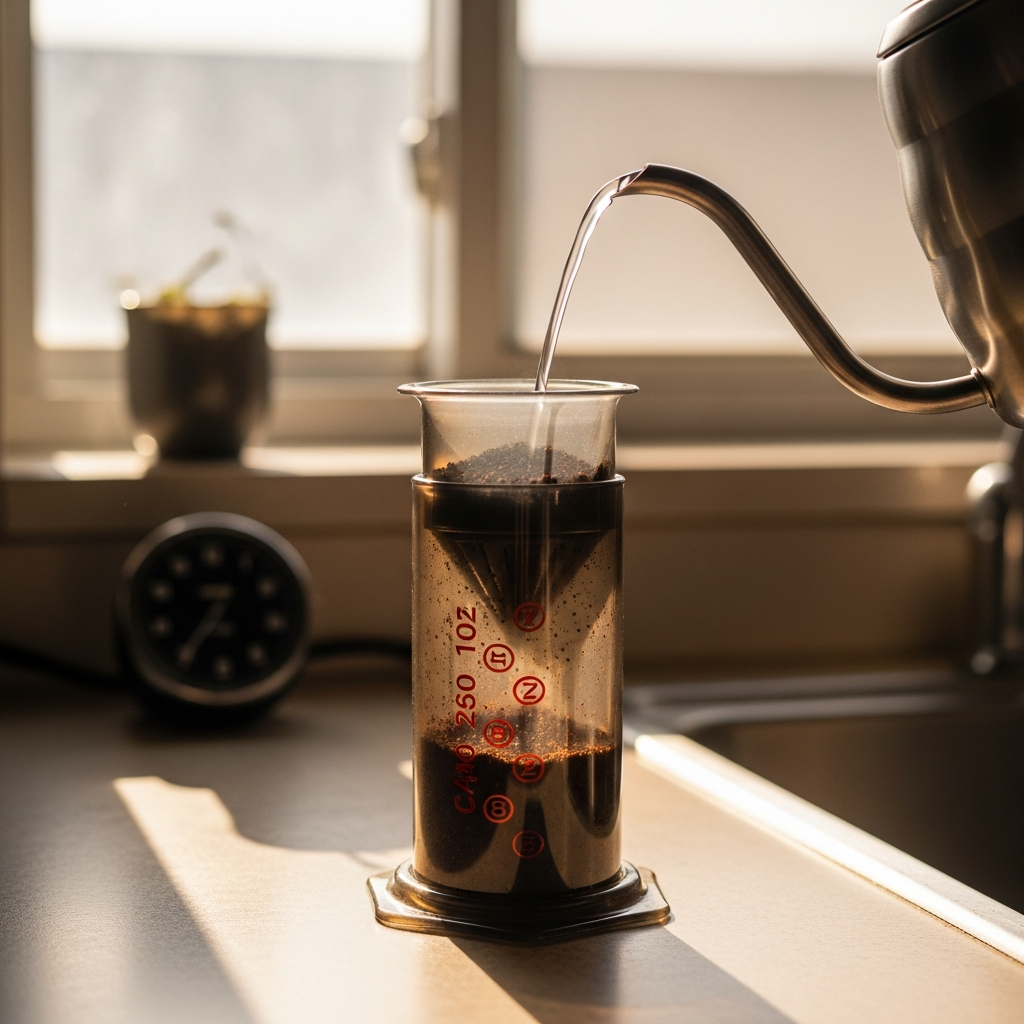
Total brew time runs about 2 minutes from first water contact to finished cup. You start with 50 grams of water — bloom, wait 30 seconds while the grounds hydrate and off-gas. Then pour the remaining 150 grams slowly over roughly 90 seconds. Then press. Steady. Deliberate. The whole thing wraps up around that 2-minute mark.
I’m putting this front and center because honestly, if you’re searching for an AeroPress recipe, you want to know whether you’re doing it right before wading through 2,000 words of coffee theory. This recipe works. It’s been made millions of times. Clean, balanced, forgiving — that’s what you’re getting.
Why These Numbers and Not the AeroPress Instructions
AeroPress recipes have gotten complicated with all the conflicting advice flying around. So let’s clear something up first.
The box tells you to use 17–18 grams of coffee and water somewhere around 195–205°F — basically boiling. That’s the factory default. It also calls for a much finer grind than Hoffmann uses.
Hoffmann threw that out the window.
The standard instructions are built for speed — high heat, tight grind, short contact time. Under a minute. But that method punishes you for small mistakes. Temperature drops fast. Channeling happens easily. One second off and the cup swings from sour to bitter. It’s a narrow window to work in.
Hoffmann’s version flips the script entirely. Lower water temperature — 85 to 90°C rather than boiling — paired with a longer steep and a lighter dose. You’re giving the coffee more time to extract evenly at a cooler temperature. Low-and-slow versus hot-and-fast. Both get you extraction. One is just far more forgiving when you’re half-asleep at 6 a.m.
The 11-gram dose matters too. That’s roughly two-thirds of what the manual suggests. Fewer grounds in the same volume of water means less density, less friction during the press, fewer places for extraction to go sideways. The water moves through more freely — and that matters when you’ve dropped below boiling.
Grind size sits at medium-fine. On my 1Zpresso JX hand grinder, that lands around 3.0 to 3.5 on the adjustment dial. On a Baratza Encore, you’re looking at roughly setting 15. Finer than pour-over, coarser than espresso. This isn’t arbitrary — it’s calibrated specifically for the 2-minute steep at 85–90°C. Too coarse and the water passes through without extracting enough. Too fine and you’re over-extracting even at lower temps.
This isn’t generic coffee advice. This is Hoffmann’s argument, tested and published. The reasoning behind each number is exactly why this recipe outperforms the dozen other AeroPress methods floating around Reddit on any given Tuesday.
Where People Screw This Up
Probably should have opened with this section, honestly. Most AeroPress failures happen at one of three points.
Grind Too Coarse
Thin cup. Watery. A little sour on the finish. That’s under-extraction.
This is the most common miss. People come from pour-over brewing, set their grinder to that same medium-coarse position, and wonder why their AeroPress tastes weak. The AeroPress is a pressure device — it needs a finer grind to work properly, especially at lower water temperatures.
Fix: go two clicks finer on your grinder. Brew again. Still sour? Two more clicks. Keep adjusting until you start tasting bitterness creeping in at the end of the cup — that’s the signal you’ve gone too far. Back off one click. That’s your sweet spot, for your specific grinder, your specific coffee.
Plunging Too Fast
You finish pressing in eight seconds instead of thirty. The cup tastes hollow, pulls apart on the palate instead of holding together.
Speed creates turbulence. Turbulence creates channels — little paths of least resistance where water rushes through without actually contacting the grounds. Uneven extraction. Boring cup. That’s what you get.
The 30-second press is not a suggestion. It’s a specific number — slow enough to prevent channeling, fast enough that you’re not squeezing out harsh compounds. Time yourself. Use the timer on your phone. You’ll be surprised how often what feels “slow” is actually faster than you think.
Water Too Hot
Standard electric kettle, shuts off at boiling, poured straight into your AeroPress — you’re hitting the grounds at 95–98°C. The result tastes sharp, a little acrid. Over-extraction.
I’m apparently the person who made this mistake for an entire month. I didn’t own a temperature-controlled kettle — just a basic $25 model from Target — and it took me way too long to figure out the problem. The fix was embarrassingly simple: boil the water, let it sit in the kettle for 3 to 4 minutes, then brew. That cooling window drops you right into the 85–90°C range. No expensive gear required. Don’t make my mistake.
If you do own a temperature-controlled kettle — a Fellow Stagg EKG, a Bonavita 1.0L, something like that — set it to 85°C and you’re done. If you don’t, the wait-and-pour method works fine.
Inverted vs Standard — Hoffmann’s Actual Position
AeroPress forums have argued about this for years. Inverted method: flip the AeroPress upside down, load the grounds, add water, then flip it onto your cup to press. Standard method: grounds in the chamber, water in, press down. Both work. They are not equal.
Hoffmann’s published recipe is clear — use the standard method. No inversion necessary.
Here’s the thing. The inverted method became popular early in AeroPress culture because people were using coarser grinds and longer steeps. With a coarse grind, water drips through slowly even without applied pressure — so you’d lose your brew while waiting. Inverting solved that problem neatly. That was around 2008 or so. But Hoffmann’s recipe uses a medium-fine grind. The grounds are tight enough to hold the water during the steep without going anywhere. Nothing drips. You don’t need the flip.
Inversion also introduces risks that just aren’t worth it. You’re holding a full, pressurized chamber upside down over your cup. Spillage happens. Burns happen. It’s an extra variable when you don’t need the variable.
For this recipe, standard wins. Simpler. Safer. Just as good — arguably better.
Adjusting for Your Coffee
Hoffmann’s baseline assumes a medium-roast filter coffee — something like a natural-process Brazilian or a washed Central American. Something approachable. But coffee varies, and roast level alone changes what you need.
Dark roasts: I bring the temperature down to around 82°C and I’m off the press by 90 seconds. Dark roasts are already pushed further through the Maillard reaction during roasting — lower temps and a shorter steep keep the cup from turning harsh and ashy.
Light roasts go the other direction. I’ll bump water up to 88–90°C and extend the steep to about 2 minutes 15 seconds. Light roasts are denser. They need the extra heat and time to open up properly.
Single-origin naturals — your fruit-forward Ethiopian Yirgacheffes, your anaerobic Colombians — sometimes taste muddled at Hoffmann’s baseline grind. Go one click coarser. You’ll tame the fruit without losing what makes it interesting.
That’s what makes this recipe endearing to us AeroPress obsessives — it’s a genuine starting point, not a fixed rule. Three adjustments. That’s your whole toolkit. Brew, taste, adjust one variable, repeat. So, without further ado, go make the cup.