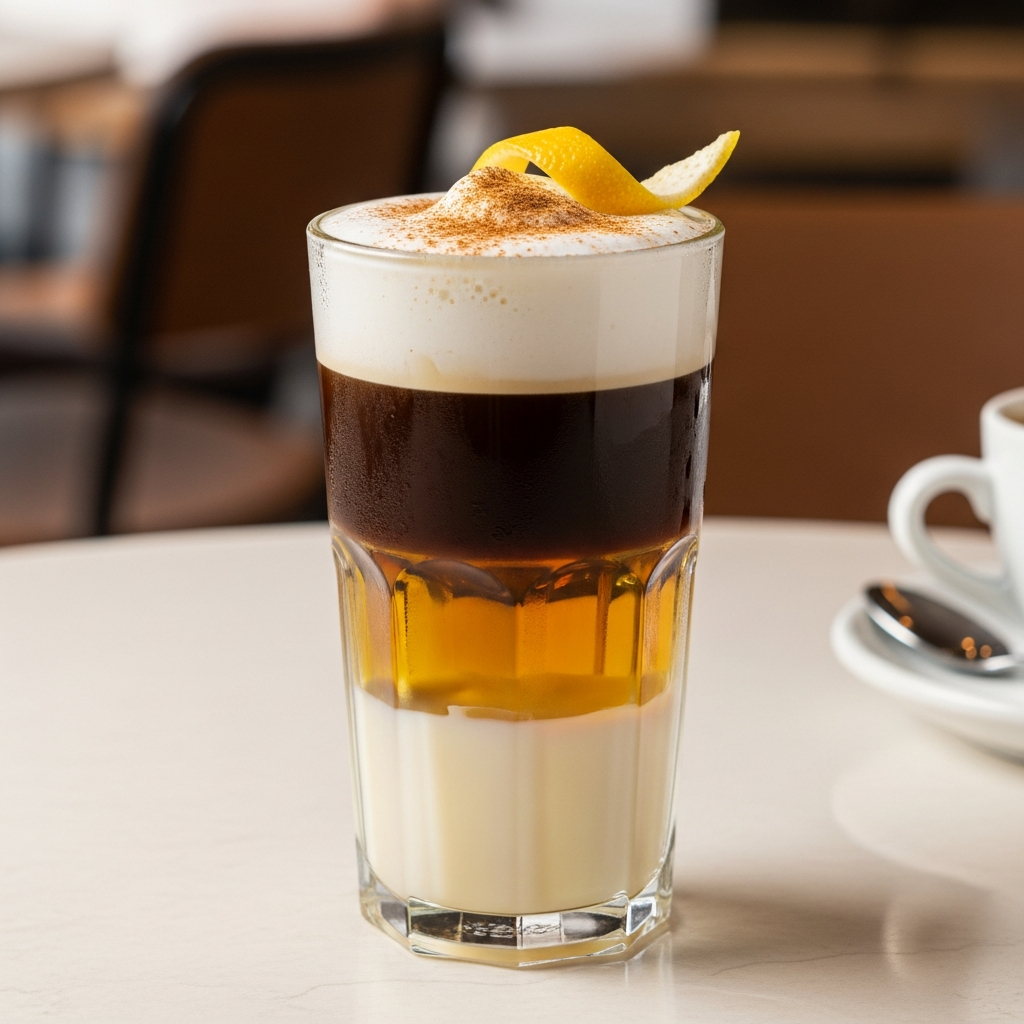
I first tried a barraquito in a cafe in Santa Cruz de Tenerife about four years ago. Five layers in a tall glass — condensed milk on the bottom, then Licor 43, espresso, frothed milk, and a curl of lemon peel dusted with cinnamon. It looked like a cocktail and tasted like dessert that somehow also wakes you up. I’ve been trying to recreate it at home ever since.
After making this drink roughly 30 times in my kitchen — five different variations across three weeks — I finally have a version I’m happy with. The classic recipe is great if you have Licor 43 on hand. But I also tested it with Frangelico, with oat milk, as cold brew, with dark chocolate, and completely alcohol-free. Here’s what worked and what didn’t.
The Classic Barraquito — Getting the Layers Right
Before you experiment, nail the baseline. The traditional barraquito from the Canary Islands has a specific layer order and getting it wrong turns a beautiful drink into brown mud.
What you need:
- 1 tablespoon sweetened condensed milk
- 1 tablespoon Licor 43 (the vanilla-citrus Spanish liqueur)
- 1 shot of espresso (about 30ml)
- Frothed milk (about 80ml, steamed to microfoam)
- A strip of lemon peel
- Ground cinnamon for dusting
- A tall, clear glass — 8oz, no handle
The layer order matters. Condensed milk goes in first — it sinks to the bottom on its own because it’s the densest liquid. Then slowly pour the Licor 43 over the back of a spoon so it floats on top. Pull your espresso directly into the glass, again pouring over a spoon. The espresso should settle as a distinct brown layer between the golden liqueur and whatever comes next. Finally, add frothed milk by pouring it gently over the spoon.
Drop the lemon peel in and dust cinnamon on top. If you did it right, you’re looking at four to five visible layers through the glass. It should look like something you’d pay $14 for at a hotel bar.
The trick that took me six attempts to figure out: glass temperature is everything. A cold glass causes the espresso and liqueur to mix on contact — I watched this happen in slow motion and wanted to throw the whole thing in the sink. Once I started running hot water through the glass for 30 seconds before building the drink, the layers held immediately. The spoon angle matters too. Hold it almost flat against the liquid surface, touching the inside of the glass, and pour onto the back of the spoon as slowly as your patience allows. Slower than you think. Slower than that.
5 Variations I Tested at Home
The classic is great. But I wanted to see what else works — and whether you can make a decent barraquito without hunting down traditional ingredients.
Variation 1: Frangelico Instead of Licor 43
Licor 43 has this unique vanilla-citrus flavor that’s hard to replicate exactly. Frangelico (hazelnut liqueur) is the closest I’ve found in terms of sweetness level and viscosity. The layers held just as well because the density is similar. Flavor was different — nuttier, less bright — but honestly quite good in its own way. If you have a bottle of Frangelico sitting in the back of a cabinet somewhere, this swap works without a second trip to the liquor store.
Verdict: Solid alternative. Different drink, still delicious. Layers held perfectly.
Variation 2: Oat Milk Foam
I use oat milk daily, so this was an obvious test. Oat milk froths differently from whole dairy — it’s lighter and the foam is airier. The layers were slightly less defined because oat foam doesn’t have the same weight as dairy microfoam. It mixed into the espresso layer faster than I wanted.
Taste-wise, the oat milk added a subtle sweetness that paired well with the Licor 43. Not quite as rich and creamy as the original, but a perfectly good version if you’re dairy-free. One thing I learned the hard way: use barista-grade oat milk. Oatly Barista edition specifically. The standard grocery store stuff froths too thin and you end up with something closer to oat water sitting on top of your espresso.
Verdict: Works, but use barista oat milk. Layers are less dramatic.
Variation 3: Cold Brew Barraquito
My worst result. Cold brew doesn’t have the temperature differential that helps the layers separate. Everything mixed together within about 10 seconds of building the drink, and I ended up with murky brown iced coffee. Tasted fine — sweet, boozy, coffee-forward — but completely lacked the visual drama that makes a barraquito a barraquito.
I tried building it over ice to slow the mixing. Didn’t help. The density differences between cold liquids are just too small to hold. Some experiments answer themselves pretty fast.
Verdict: Tastes okay. Looks terrible. Skip unless you don’t care about layers.
Variation 4: Dark Chocolate Addition
I melted a tablespoon of dark chocolate (70% cacao) and layered it between the condensed milk and the Licor 43. A five-layer drink became six layers. The chocolate created this gorgeous dark band at the very bottom of the glass — almost black against the pale condensed milk.
Flavor-wise, the chocolate pushed it firmly into dessert territory. The bitterness balanced the sweetness of the condensed milk and liqueur in a way I wasn’t expecting. My wife, who doesn’t usually drink coffee drinks, finished this one and asked me to make another. That’s the best endorsement I’ve got.
Verdict: Best variation I tested. Extra effort but worth it for a weekend treat.
Variation 5: Non-Alcoholic Version
The traditional alcohol-free barraquito (called a barraquito virgen) just drops the Licor 43 entirely. That works, but it leaves a gap — both visually and in flavor. You’re missing a whole layer and the vanilla-citrus dimension just disappears.
My fix: replace the Licor 43 with a 50/50 mix of vanilla syrup and a squeeze of fresh lemon juice. The vanilla picks up the sweetness, the lemon adds the citrus brightness, and the combined density is close enough to hold a separate layer. Not identical to the original, but much closer than just leaving the liqueur out. I’ve made this version on weekday mornings more than I expected.
Verdict: Best non-alcoholic option I found. The vanilla-lemon swap is the key.
The Layering Trick That Actually Works
I failed at layering for my first five or six attempts. The espresso kept crashing through the Licor 43 and mixing everything into a uniform beige. Eventually figured it out. Here’s what actually matters.
Warm the glass first. Run hot tap water through it for 30 seconds, then dump. A warm glass keeps the liquids at more consistent temperatures, which makes the density differences work in your favor instead of against you. This one change fixed about 80% of my layering failures.
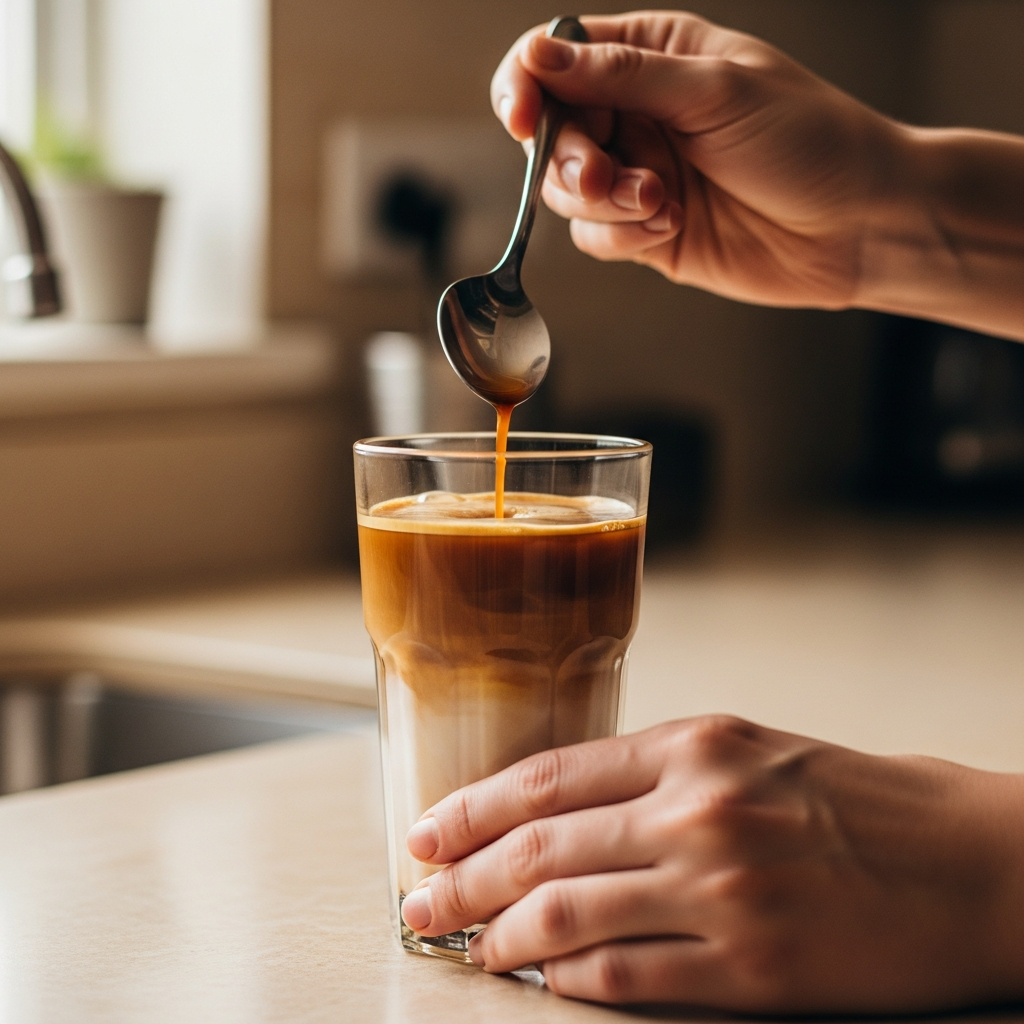
Pour over a spoon held flat. Not tilted at 45 degrees — nearly horizontal, with the back of the spoon barely touching the surface of the liquid below. Pour onto the spoon so slowly it barely moves. The liquid should sheet off the edges and settle gently rather than plunging straight through.
The espresso layer is the hardest one. It’s hot and fast-moving, which means it wants to punch through the liqueur layer. Best results: pull your espresso into a separate cup first, then pour from the cup over the spoon. Pulling directly into the glass from the machine creates too much turbulence right at the start.
Don’t stir. Don’t touch it. Don’t breathe on it. Once the layers are set, they’re fragile. Put the lemon peel in gently from the side. Dust the cinnamon from 6 inches above so you don’t disturb the foam. Serve immediately — the layers start blending after about 3-4 minutes regardless, so there’s no point fussing with presentation once it’s built.
Where to Get Licor 43 (and What to Use Instead)
Licor 43 is Spain’s best-selling liqueur and it’s getting easier to find in the US, but it’s not everywhere. Total Wine carries it in most locations for around $25 a bottle. BevMo usually has it. Smaller liquor stores are hit or miss — I had to check three stores before I found a bottle, and one of them had never heard of it.
If you can’t find it or don’t want to spend $25 for what might be a one-time experiment, here are the substitutes I tested, ranked by how close they come:
- Frangelico — Different flavor (hazelnut vs vanilla-citrus) but same sweetness level and excellent layer behavior. Best overall substitute.
- Vanilla syrup + lemon juice (non-alcoholic) — Surprisingly close in function. Mix 1 tbsp vanilla syrup with 1 tsp lemon juice. Layers held about 80% as well.
- Galliano — Vanilla-anise profile is in the right neighborhood. Layers fine. Slightly more herbal than Licor 43.
- Tuaca — Vanilla-citrus Italian liqueur that’s actually the closest flavor match I found. The problem is Tuaca is even harder to find than Licor 43 in most US markets. Not worth the hunt.
What I’d skip: Kahlua (too heavy, kills the layers), Baileys (wrong density, turns everything muddy), or amaretto (overpowers the coffee completely). I tried all three so you don’t have to.
My Verdict: Which Version I Keep Making
The classic with Licor 43 is still my go-to when I want to impress someone. The dark chocolate variation is what I make for myself on a lazy Sunday morning with nowhere to be. And the non-alcoholic version with vanilla syrup and lemon is what I default to on weekday mornings when I want something more interesting than a regular latte but don’t need the Licor 43 situation before 9am.
If you’ve never made a barraquito before, start with the classic recipe and nail the layering technique first. Once you can consistently get four clean layers, then start playing with variations. Trying to do both at the same time — a new recipe and a technique you haven’t learned yet — is how you end up with a glass of expensive brown milk. Trust me.