A typical home coffee mug holds 8–12 US fluid ounces (240–355 ml). Most are about 3.5–4.5 inches (9–11.5 cm) tall and roughly 3–3.5 inches (7.5–9 cm) across, excluding the handle—but there is no universal standard.
Choose by usable capacity first. Espresso needs a 2–3 oz cup, cappuccino about 5–6 oz, a regular mug 8–12 oz, and a latte or travel drink commonly 12–16 oz. Dimensions vary widely with shape and wall thickness.
Coffee Cup Sizes Chart
| Cup type | Typical capacity | Approx. milliliters | Common use |
|---|---|---|---|
| Demitasse | 2–3 fl oz | 60–90 ml | Espresso, ristretto, macchiato |
| Cortado glass | 4–4.5 fl oz | 120–135 ml | Cortado, Gibraltar-style drinks |
| Cappuccino cup | 5–6 fl oz | 150–180 ml | Traditional cappuccino, small flat white |
| Small mug | 6–8 fl oz | 180–240 ml | Filter coffee, flat white, small Americano |
| Standard mug | 8–12 fl oz | 240–355 ml | Drip coffee, Americano, tea |
| Latte mug or glass | 10–16 fl oz | 295–475 ml | Latte, mocha, larger milk drinks |
| Travel mug | 12–20 fl oz | 355–590 ml | Hot coffee on the go |
| Iced-drink tumbler | 16–24 fl oz | 475–710 ml | Iced coffee, cold brew, iced latte |
For branded café drinks, use the chain’s current menu rather than this general chart. We keep Starbucks cup sizes on a separate page so the two topics do not conflict.
What Is the Average Coffee Mug Size?
The most useful answer is 8–12 oz (240–355 ml). A compact diner mug may hold about 8 oz, while common household ceramic mugs are frequently 10–12 oz. Oversized mugs can exceed 16 oz.
Capacity printed by a manufacturer usually means liquid filled close to the rim. Comfortable working capacity is lower: leave roughly 0.5–1 inch of headspace for carrying, milk, foam or stirring.
Average Coffee Mug Dimensions
| Mug capacity | Typical height | Typical body diameter |
|---|---|---|
| 6–8 oz | 3–3.75 in / 7.5–9.5 cm | 2.75–3.25 in / 7–8.25 cm |
| 10–12 oz | 3.5–4.5 in / 9–11.5 cm | 3–3.5 in / 7.5–9 cm |
| 14–16 oz | 4–5.25 in / 10–13.5 cm | 3.25–4 in / 8.25–10 cm |
| 12–20 oz travel mug | 6–8.5 in / 15–21.5 cm | 2.6–3.5 in / 6.5–9 cm at base |
If fit matters, measure the actual product. Dishwasher racks, coffee-machine clearance, cabinet shelves and car cupholders depend on external height and diameter—not liquid capacity.
Why “One Cup of Coffee” Is Confusing
Several different measurements use the word cup:
- US measuring cup: 8 US fluid ounces, about 237 ml.
- Coffee-maker cup: often 5–6 fl oz, depending on the manufacturer.
- Everyday coffee mug: commonly 8–12 fl oz.
- Moka-pot cup: a small concentrated serving, not a full mug.
- Café size: whatever volume that café assigns to small, medium and large.
This is why a “12-cup” drip machine may not fill twelve household mugs. Check the carafe markings and manual. Moka brewers use their own small-serving convention; our moka pot size chart converts those sizes to actual milliliters.
Best Cup Size by Coffee Drink
Espresso: 2–3 oz
A demitasse leaves room above a single or double espresso without spreading the small drink across a large cold surface. Preheating the cup matters more than decorative shape.
Cappuccino: 5–6 oz
This size accommodates espresso plus steamed milk and foam without turning the drink into a large latte. A rounded interior can help pouring and spooning, but it does not keep ingredients in permanent layers.
Flat white: 5–8 oz
Flat-white sizes vary by country and café. A smaller cup preserves an espresso-forward balance; larger versions contain more milk.
Drip coffee or Americano: 8–12 oz
An 8–12 oz mug fits a normal home serving and leaves room for milk. For the espresso-and-water drink itself, see what an Americano is.
Latte: 10–16 oz
Milk drinks need more volume. A 10–12 oz vessel keeps the coffee more prominent, while 14–16 oz allows more steamed milk, foam and flavored syrup.
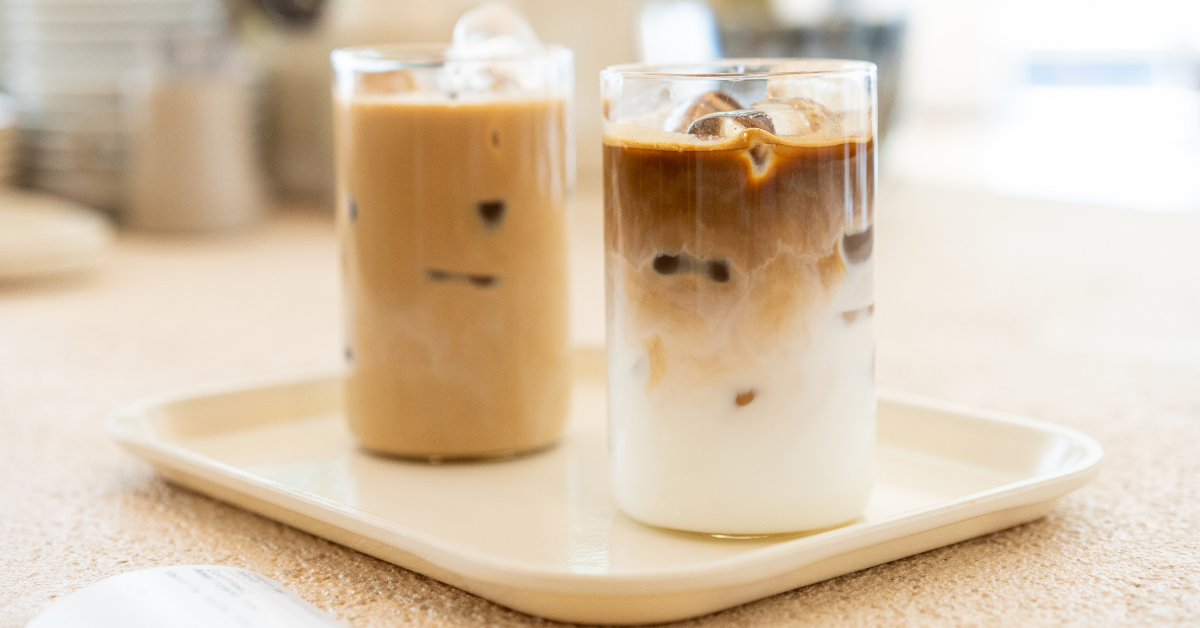
Iced coffee: 16–24 oz
Ice occupies substantial space, so cold drinks need a larger vessel than the liquid volume alone suggests. Choose a lid and straw opening that match how you will use it.
How to Choose a Mug
- Measure your normal pour. Fill your current cup to a comfortable level, then pour it into a measuring jug.
- Add headspace. Allow room for milk, foam and movement.
- Check machine clearance. Measure from drip tray to spout.
- Check external fit. Include the handle, lid and widest point.
- Choose heat behavior. Thick ceramic retains heat; double-wall glass insulates while showing the drink; metal suits travel.
- Confirm care instructions. Dishwasher and microwave safety depend on the material, glaze and decoration.
Does Mug Size Change Caffeine?
The container does not determine caffeine. Caffeine depends on the coffee, dose and brewing recipe poured into it. A 20 oz mug does not automatically contain a particular milligram amount; it may hold weak coffee, strong coffee, milk or only a partial fill.
Track the beverage recipe and serving volume, not the mug’s maximum capacity.
Coffee Cup Size FAQ
Is a standard coffee cup 6 or 8 ounces?
Neither is universal. A US measuring cup is 8 fl oz, many coffee machines call roughly 5–6 fl oz a cup, and household mugs commonly hold 8–12 fl oz.
How many ml is a normal coffee mug?
About 240–355 ml is a practical normal range, corresponding to 8–12 US fl oz.
What size mug fits under a coffee machine?
Measure the machine’s vertical clearance with its drip tray installed. Compare that with the mug’s external height; capacity alone cannot tell you whether it fits.
Bottom Line
For a general-purpose home mug, choose 10–12 oz (295–355 ml). Go smaller for espresso and traditional cappuccino, or larger for lattes, travel and iced drinks. Treat all dimension ranges as estimates and verify the actual vessel when fit matters.